Cuibit publishes insights from shipped delivery work across web, WordPress, AI and mobile. Articles are written for real buying and implementation decisions, then updated as the stack or the advice changes.
Cuibit AI Systems
Applied AI and LLM delivery team
The Cuibit team focused on production RAG, LLM integration, workflow automation, evaluation and model cost control.
Key takeaways
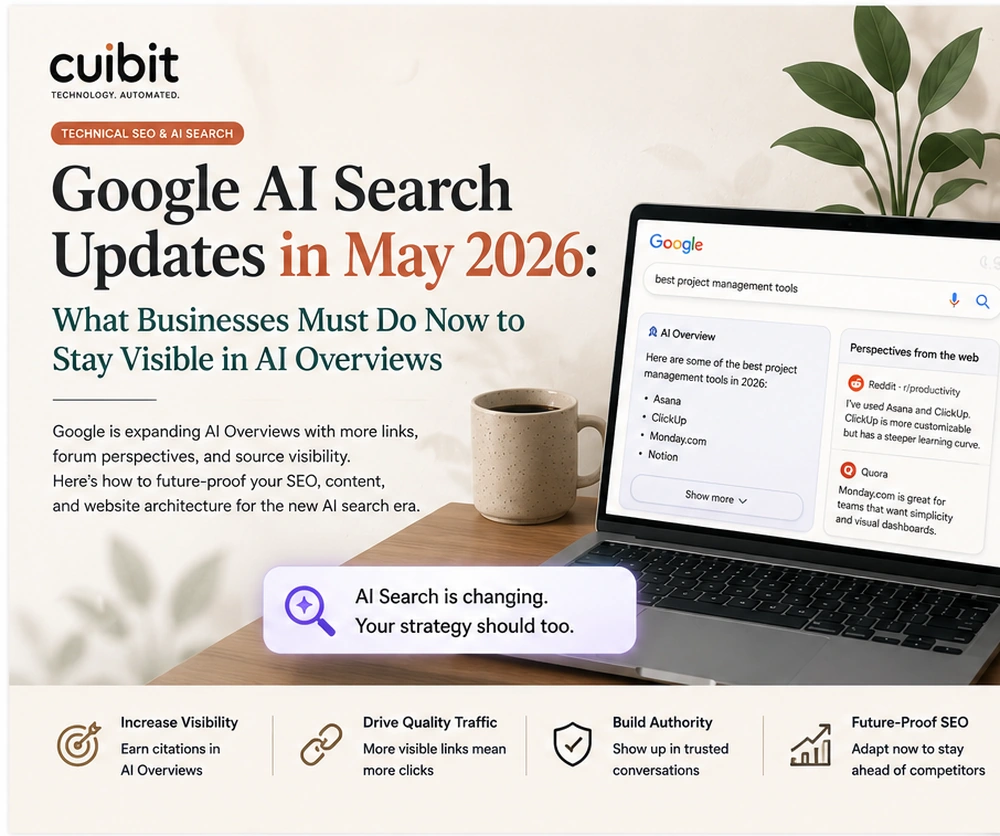
- Google AI Search is becoming more link-rich, source-aware, and experience-led. The same-day updates around AI Mode and AI Overviews point toward more inline links, forum perspectives, expert advice, subscription source personalization, and deeper follow-up paths.
- Business websites should not respond by publishing generic AI content. The practical response is stronger technical SEO, better page architecture, clearer entities, useful proof, crawlable content, and pages that answer real buyer questions.
- Forum and community perspectives matter because Google is trying to surface first-hand experience. Service businesses, SaaS companies, ecommerce stores, and WordPress sites need content that includes real examples, constraints, tradeoffs, and decision help.
- Technical foundations still matter. Search systems need accessible HTML, fast pages, clean metadata, accurate schema, strong internal links, reliable rendering, useful images, and content that matches the visible page.
- Ecommerce and SaaS websites should treat product data, service pages, comparison content, case studies, FAQs, and support documentation as one connected visibility system.
- The safest strategy is to audit the website around buyer tasks, not only keywords. Ask whether each important page helps a real buyer understand the problem, compare options, verify trust, and decide the next step.
Why this topic matters today
Google's latest AI Search updates are important because they show where search is heading. AI Mode and AI Overviews are no longer only short answer boxes. They are becoming research surfaces with more inline links, next-step prompts, forum-style perspectives, expert advice, and source context. That changes how business websites should think about technical SEO.
A traditional SEO plan often starts with keywords, titles, headings, and backlinks. Those still matter, but AI-assisted search adds a wider question: does the page provide enough clear, useful, verifiable information to be selected, summarized, linked, and trusted inside a conversational research flow?
That matters for service companies, ecommerce stores, SaaS products, WordPress sites, and custom web platforms. A buyer may now ask a longer question, review an AI-generated summary, inspect source links, compare first-hand opinions, open a few pages, and continue asking follow-ups. A weak page may still exist in the index, but it may not earn attention inside that process.
For Cuibit, this topic connects naturally to web development services, technical SEO, WordPress optimization, WooCommerce engineering, AI search strategy, and modern frontend architecture. The goal is not to chase a search feature. The goal is to build websites that are easy for both humans and AI systems to understand.
What changed in Google AI Search
The most important change is that AI Search is becoming more layered. Users are not only receiving a single answer. They are being guided toward related sources, deeper questions, and different perspectives.
For businesses, that means search visibility is less about one page matching one query. It is more about whether the website can support a complete research path. A buyer might start with a broad question, move into a comparison, inspect forum-style advice, check a vendor's service page, read a case study, and then ask a more specific implementation question.
Google's focus on first-hand perspectives is also significant. Many users already add terms such as Reddit, forum, review, or experience to their searches because they want human context. When AI Search surfaces these perspectives more directly, brands with only polished marketing language may look less useful than brands that explain real implementation details.
This does not mean every business should create a forum or pretend to be a community. It means the website should include the type of information people usually search forums for: what goes wrong, what costs more than expected, which option fits which situation, what tradeoffs matter, what a realistic timeline looks like, and what mistakes buyers should avoid.
Why technical SEO is still the foundation
AI Search does not remove the need for technical SEO. It makes weak technical foundations more expensive.
If important content is hard to crawl, hidden behind fragile JavaScript, duplicated across many thin pages, blocked by poor navigation, or slowed down by heavy scripts, the website gives search systems less reliable information. If structured data says one thing and the visible page says another, the website creates trust problems. If service pages are vague, AI-assisted answers have little substance to cite or summarize.
A good technical SEO foundation includes:
- crawlable pages
- indexable canonical URLs
- useful titles and descriptions
- clear heading structure
- accessible internal links
- fast mobile performance
- stable layouts
- clean image handling
- accurate schema
- consistent entity information
- readable visible content
- helpful related pages
This is especially important for JavaScript-heavy websites. React and Next.js can support excellent SEO, but only when rendering, metadata, routing, caching, and content delivery are implemented carefully. A polished interface is not enough if search systems cannot reliably see the important content. Businesses using modern frameworks should consider a deliberate Next.js development approach when performance, crawlability, and content operations all matter.
For WordPress sites, the same principle applies in a different way. Plugin bloat, slow themes, poor image sizes, weak caching, layout shifts, and cluttered page builders can all weaken AI Search readiness. If the content is good but the site is slow or unstable, WordPress speed optimization may be the most valuable first step.
How AI Search changes content architecture
AI-assisted search rewards pages that answer full tasks. A task is broader than a keyword. For example, a buyer might not only search for "WooCommerce developer." They may ask, "Should we keep WooCommerce or move to a headless storefront if our catalog is large, our site is slow, and our checkout needs custom B2B pricing?"
That question combines platform strategy, performance, catalog architecture, checkout logic, pricing rules, development cost, migration risk, and business impact. A simple service page cannot answer everything, but a well-built content cluster can.
This is where architecture matters. A business website should connect:
- core service pages
- comparison pages
- implementation guides
- case studies
- portfolio examples
- FAQs
- pricing logic
- technical explainers
- support documentation
- trust pages
For example, a WooCommerce-focused site should connect category strategy, product data quality, checkout optimization, performance, custom plugin work, and maintenance. A SaaS website should connect use cases, integrations, security, pricing, implementation, comparisons, documentation, and proof.
Cuibit's guide on how to audit a website for AI search visibility is useful here because it treats AI visibility as a full-site quality issue rather than a single metadata task.
What forum and expert-perspective results mean for brands
Google's emphasis on forum and expert perspectives creates a practical challenge for brands: buyers want lived experience, not only positioning.
A business website can respond in several ways.
First, include real constraints. If a service has tradeoffs, say so. If a migration needs careful planning, explain why. If a cheap implementation usually creates long-term maintenance problems, describe the risk.
Second, include examples. A page about ecommerce performance should not only say that speed matters. It should explain image optimization, caching, plugin review, database cleanup, checkout testing, hosting limits, and Core Web Vitals monitoring.
Third, include decision help. A buyer should be able to understand when one option is better than another. For example, headless WooCommerce may be valuable for some stores, but unnecessary for others. A custom React dashboard may be useful for complex internal operations, but not for a simple reporting need.
Fourth, include proof. Case studies, portfolio pages, screenshots, before-and-after examples, and architecture notes help connect claims to reality. Generic trust badges are weaker than specific evidence.
This is why entity clarity matters. Search systems and buyers need to understand who the company is, what it does, what proof supports the claim, and which services connect to which outcomes. Cuibit's article on entity SEO for AI search covers this in more detail.
A practical AI Search technical SEO checklist
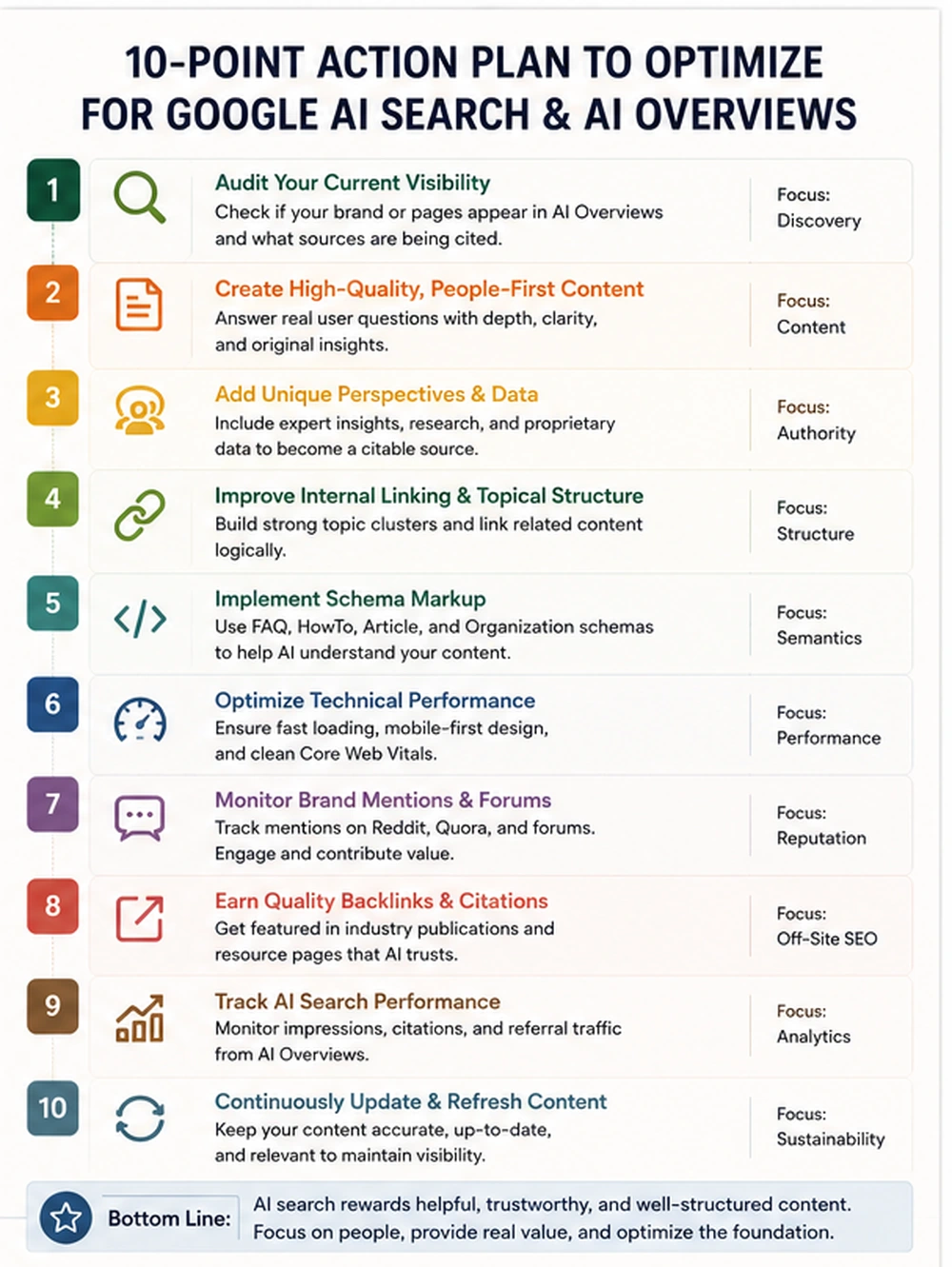
Use this checklist to inspect whether a business website is ready for the new AI Search environment.
1. Confirm crawlability and indexability
Start with basics. Important pages should not be blocked by robots.txt, noindex tags, broken canonical tags, login walls, or unreliable JavaScript rendering. Search Console should show that key pages are discovered, crawled, indexed, and free from major technical issues.
For large websites, prioritize revenue pages first. These include service pages, product pages, category pages, comparison pages, case studies, portfolio pages, pricing pages, and high-intent articles.
2. Improve page clarity
Every important page should quickly answer:
- What is this page about?
- Who is it for?
- What problem does it solve?
- What should the reader do next?
- What evidence supports the claim?
A vague page is hard for buyers to use and hard for AI systems to summarize well. Clear pages use direct headings, specific examples, short explanations, and logical sections.
3. Make internal links useful
Internal links should guide the buyer through a decision. They should not be added only because an SEO checklist says so.
A page about AI visibility might naturally link to how to appear in AI-generated answers without publishing generic AI content. A page about ecommerce platform improvement might link to WooCommerce development. A page about technical rebuilds might link to relevant web engineering or case study pages.
The anchor should describe what the user will get. Repeating the same keyword anchor across the site looks forced and does not help the reader.
4. Add visible proof
AI Search may surface links and source context, but the destination still needs to persuade a human. Add proof where buyers make decisions.
Useful proof includes:
- case studies
- portfolio examples
- screenshots
- architecture notes
- measurable improvements
- process explanations
- client-type examples
- risk notes
- delivery constraints
For ecommerce work, a relevant example such as Cuibit's B2B WooCommerce rebuild can help show that platform decisions involve catalog structure, role-based buying, performance, and business logic, not just theme design.
5. Align schema with visible content
Structured data should support the visible page. It should not invent claims, reviews, ratings, FAQs, or product details that users cannot see.
For service businesses, Organization, Breadcrumb, Article, FAQ, and Service-related structured data can help where appropriate. For ecommerce, product schema must be accurate, especially price, availability, images, reviews, and variants.
The rule is simple: if structured data describes it, the page should clearly support it.
6. Improve performance and user experience
AI Search visibility has little business value if users click through to a slow, unstable page. Performance still affects trust, conversion, and usability.
Focus on:
- compressed images
- stable layouts
- reduced script load
- proper caching
- fast hosting response
- mobile navigation
- accessible forms
- readable content width
- fewer intrusive popups
- clear calls to action
Performance is not only a technical metric. It is part of the buyer experience.
7. Build comparison and decision pages
AI-assisted buyers often compare options. If your website does not help with comparison, another source will.
Useful comparison content might explain:
- WordPress vs headless architecture
- WooCommerce optimization vs rebuild
- React vs WordPress for a specific business need
- custom web development vs template-based implementation
- AI chatbot vs RAG knowledge assistant
- Flutter vs React Native for a mobile app
Comparison pages should be honest. They should explain when each option fits and when it does not.
8. Monitor query patterns and assisted outcomes
Reporting for AI Search surfaces is still imperfect. Do not wait for perfect dashboards. Use a mix of signals:
- Search Console page and query trends
- landing page engagement
- referral patterns
- conversion quality
- form submissions
- sales call notes
- support questions
- CRM source context
- ranking changes for decision queries
The goal is to understand whether better pages are attracting better buyers.
How ecommerce websites should respond
Ecommerce websites should treat AI Search readiness as a product data and page quality problem.
A product page should include accurate titles, rich attributes, strong images, price, availability, variants, shipping information, return policy, reviews, FAQs, and helpful product context. Category pages should explain how to choose, not only display a grid.
For WooCommerce stores, the technical layer matters. Many stores start simple and become complex over time. Plugins accumulate, product data gets messy, filters slow down, checkout becomes fragile, and performance declines. In that state, publishing more content will not solve the real issue.
A stronger plan includes:
- product data cleanup
- category page improvement
- schema validation
- image optimization
- checkout performance review
- plugin audit
- caching setup
- database cleanup
- mobile purchase flow testing
- internal links from guides to products
AI Search can only work with the information the store provides. If the product catalog is incomplete, visibility and conversion both suffer.
How SaaS websites should respond
SaaS websites should move beyond feature lists. AI-assisted buyers want decision support.
Useful SaaS pages explain use cases, integrations, pricing logic, implementation timelines, migration risks, data permissions, security, reporting, and proof. A buyer should understand whether the product fits their team before booking a demo.
SaaS teams should improve:
- use-case pages
- integration pages
- pricing explainers
- security pages
- comparison pages
- implementation guides
- customer proof
- help center quality
- product screenshots
- onboarding content
For SaaS products built with modern frameworks, performance and rendering are important. A site built with React, Next.js, or a headless CMS should be checked for metadata, server-rendered content, internal links, sitemap quality, and page speed.
How service businesses should respond
Service businesses often have the biggest opportunity because many service websites are still vague. They describe services in broad terms but do not help buyers understand scope, process, pricing factors, risks, or proof.
A serious service page should include:
- who the service is for
- what problems it solves
- what is included
- what is not included
- typical process
- technical decisions
- risks to avoid
- proof and examples
- FAQs from real sales calls
- clear next step
This approach matches Google's people-first direction because it helps the reader make a better decision even if they do not contact the company.
When a website needs a rebuild instead of optimization
Some websites can be improved with targeted fixes. Others need a deeper rebuild.
Optimization may be enough when the CMS is healthy, pages are indexable, templates are flexible, performance issues are fixable, and the information architecture still matches the business.
A rebuild may be necessary when important content is trapped in poor templates, the site is too slow at the foundation, JavaScript rendering is unreliable, the CMS blocks publishing, analytics are broken, navigation no longer matches services, or service pages cannot support proof and comparison sections.
A rebuild should not be cosmetic. It should improve technical access, content operations, speed, trust, internal links, conversion paths, and measurement. Cuibit's case studies show why serious digital projects usually combine strategy, design, engineering, and business logic.
A 30-day action plan
Week 1: Audit the pages that affect revenue
Choose 10 to 20 pages that matter most. Include service pages, product pages, category pages, high-intent guides, portfolio examples, case studies, and comparison pages.
Check crawlability, indexability, titles, headings, internal links, schema, performance, and conversion paths.
Week 2: Rewrite for buyer tasks
For each page, define the buyer task. Then revise the page so it answers the task clearly. Add examples, tradeoffs, proof, FAQs, and next steps.
Week 3: Fix the technical layer
Address performance, rendering, metadata, schema, image sizes, mobile usability, broken links, duplicate content, and analytics gaps.
Week 4: Connect and measure
Improve internal links, connect supporting content to service pages, track search and conversion quality, and gather sales feedback. Treat the first month as the beginning of a continuous improvement cycle.
Editorial conclusion
Google AI Search is not a reason to abandon SEO fundamentals. It is a reason to do them with more discipline.
The websites that benefit will be the ones that are technically accessible, fast, clear, specific, internally connected, and useful to real buyers. The websites that struggle will be the ones relying on vague claims, thin AI content, weak proof, slow pages, and disconnected blog posts.
For business leaders, the practical move is to stop thinking of AI Search as a separate trick. It is a quality test for the whole website. If your pages help real people understand the problem, compare options, verify trust, and take the next step, they are better prepared for AI-assisted discovery.
Start with the pages closest to revenue. Make them clearer, faster, better structured, and more useful. That is the work that compounds.
Need this advice turned into a real delivery plan?
We can review your current stack, pressure-test the tradeoffs in this guide and turn it into a scoped implementation plan for your team.