Cuibit publishes insights from shipped delivery work across web, WordPress, AI and mobile. Articles are written for real buying and implementation decisions, then updated as the stack or the advice changes.
Cuibit AI Systems
Applied AI and LLM delivery team
The Cuibit team focused on production RAG, LLM integration, workflow automation, evaluation and model cost control.
Key takeaways
- AI-assisted search is changing how ecommerce and SaaS buyers discover, compare, and choose products. The website now has to support both human evaluation and AI interpretation.
- Ecommerce visibility depends on product data quality, not only blog content. Product feeds, product pages, category pages, schema, reviews, images, availability, and policies all need to agree.
- SaaS visibility depends on decision-ready pages. Buyers need use cases, integrations, pricing logic, implementation details, proof, comparison content, and clear next steps.
- Google AI Mode and AI-powered shopping experiences increase the value of structured, accurate, specific website information. Vague claims and incomplete data are easier to ignore.
- Paid and organic discovery are becoming more connected because AI-powered ads and AI-organized results depend heavily on landing page relevance, feed quality, and product or service clarity.
- The practical plan is to audit crawlability, structured data, product or feature data, performance, trust signals, internal links, analytics, and conversion paths before publishing more generic content.
Why this topic matters now
Google is moving search and shopping toward AI-assisted discovery. For ecommerce and SaaS companies, this is not a small channel update. It changes how prospects find options, compare choices, inspect trust signals, and decide which product or vendor deserves attention.
A shopper can now ask a broad question and expect product recommendations, buying factors, price context, review signals, seller options, and follow-up support. A SaaS buyer can ask a detailed question about tools for a specific company size, integration stack, budget, or workflow and receive a structured comparison. A search session that used to require many separate searches can become one longer evaluation.
That means the website has to do more than rank for a short keyword. It has to become a reliable source for AI-assisted discovery and a useful destination when a buyer clicks through.
For Cuibit, this topic sits at the intersection of web development services, ecommerce engineering, AI search strategy, and technical SEO. A modern ecommerce or SaaS site is no longer just a storefront, brochure, or product catalog. It is a structured evidence layer that helps search systems and real buyers understand what the business offers, why it matters, and whether it fits the buyer's situation.
The shift from search results to decision surfaces
For years, search optimization was mostly framed around pages and rankings. A page ranked, a user clicked, and the website did the rest. That pattern still exists, but it is no longer the full story.
AI-assisted search creates decision surfaces. A decision surface is any search or assistant experience where the user can compare options, ask follow-up questions, see summarized evidence, and move closer to action without immediately browsing many pages.
For ecommerce, a decision surface might show product options, product attributes, visual examples, prices, reviews, sellers, stock signals, and buying paths. For SaaS, it might show product categories, vendors, common use cases, comparison criteria, integrations, and questions to ask before buying.
This makes data quality and page clarity much more important. If your store has thin product descriptions, missing attributes, inconsistent prices, weak images, or poor availability data, AI-assisted shopping journeys have less reliable information to work with. If your SaaS site hides implementation details behind generic copy, the AI-assisted answer may describe the category but skip your company as a useful source.
The practical takeaway is simple: your website must become easier to understand, cite, compare, and trust.
Ecommerce visibility: product data is now content strategy
Many ecommerce teams still separate product feed work from content strategy. That split is increasingly risky.
In AI-assisted shopping, the product feed, category page, product detail page, review profile, images, structured data, shipping policy, return policy, and inventory signals all help form the buyer's understanding. If the product page says one thing, the feed says another, and the structured data is incomplete, the store creates friction for both search systems and customers.
A serious ecommerce visibility plan should start with product data completeness. The core fields matter: product title, product type, brand, price, availability, images, variants, color, size, material, dimensions, reviews, ratings, shipping, return details, and unique selling points. For more complex catalogs, attributes such as compatibility, use case, warranty, certifications, industry, fit, bundle options, and replacement parts can make the difference between being understood and being skipped.
This is where many WooCommerce stores need engineering and content work together. A store can have a functional checkout but still have weak discovery because the catalog is inconsistent. A project using WooCommerce development should not only focus on payment, shipping, and checkout. It should also address catalog modeling, structured attributes, product templates, category logic, filtering, schema, performance, and editorial control.
The strongest ecommerce pages answer product questions before the buyer has to ask them. They explain fit, tradeoffs, alternatives, dimensions, compatibility, maintenance, shipping constraints, and buyer confidence signals. AI-assisted shopping does not remove the need for product pages. It raises the standard for what those pages need to provide.
SaaS visibility: feature lists are not enough
SaaS websites often suffer from a different problem. They may have good design and polished messaging, but the content is too vague for serious evaluation.
A page that says manage your workflow with intelligent automation does not help a buyer compare options. A buyer wants to know which workflows are supported, what integrations exist, what setup requires, what data is stored, how permissions work, what reporting looks like, what happens during migration, which team owns administration, and what results are realistic.
AI-assisted search makes these gaps more visible because the buyer can ask longer, more specific questions. For example:
- What project management tool is best for a 70-person agency using Slack, Google Workspace, and client approvals?
- Which customer support platform supports AI triage, multilingual tickets, and human escalation?
- What should a small SaaS company use for product analytics if it needs event tracking, cohort analysis, and CRM sync?
If your SaaS website only targets broad category terms, it may miss higher-value decision queries. The better approach is to build use-case pages, integration pages, comparison pages, implementation guides, security pages, pricing explainers, and buyer checklists.
For teams building or rebuilding SaaS sites, this is also a web architecture problem. A strong SaaS site should support flexible content models, fast landing pages, clean routing, reusable comparison sections, and data-driven conversion tracking. Modern frameworks such as Next.js development can help when the implementation supports crawlability, performance, clean metadata, and maintainable content operations.
What Google AI Mode changes for landing pages
AI Mode creates a different expectation for landing pages because the user often arrives with more context. They may have already seen a summarized answer, compared options, or asked follow-up questions. When they click, they expect the page to continue the decision, not restart from a generic headline.
That means a landing page needs to be sharper.
For ecommerce, the landing page should quickly confirm product relevance, price, availability, variants, shipping expectations, trust signals, and alternatives. For SaaS, it should quickly confirm the use case, the buyer type, the implementation path, the pricing logic, integrations, proof, and the next step.
The page also needs to be technically dependable. If the experience is slow, unstable, hidden behind scripts, overloaded with popups, or difficult to use on mobile, the AI-assisted click has less value. A user who is already comparing options will not wait long for a broken page to explain itself.
This is why technical SEO, content strategy, and product engineering need to work together. The best page is not just the one with the right keywords. It is the one that loads quickly, presents the right evidence, answers the next question, and offers a clear action.
Structured data: useful, but not a replacement for real content
Structured data matters because it helps search systems understand products, reviews, organizations, FAQs, breadcrumbs, articles, videos, and other page elements. But structured data should describe visible, accurate content. It should not be used to imply details that users cannot verify on the page.
For ecommerce sites, product schema should match the real product page. Price, availability, ratings, images, variants, and seller information need to be accurate. If the page changes frequently, the data layer should update reliably. If the feed, schema, and page disagree, the business creates trust problems.
For SaaS sites, structured data can help clarify organization details, software applications, FAQs, articles, breadcrumbs, and review content where appropriate. But the larger job is still visible clarity. A page that explains integrations, implementation, security, pricing factors, and use cases in plain language is more useful than a thin page with decorative markup.
A good rule: write the page for the buyer first, then use structured data to reinforce what the buyer can already see.
Build pages around real buyer questions
A strong AI search visibility plan starts with buyer questions, not keyword volume alone. Keyword research still matters, but AI-assisted search expands the query shape. Buyers ask full questions, combine constraints, and compare tradeoffs.
For ecommerce, buyer questions often include:
- Which product is best for my use case?
- What is the difference between these variants?
- Will this work with my existing setup?
- What do reviews say about durability or fit?
- Is the price justified?
- Can I return it if it does not work?
- Is this product available now?
- What should I buy with it?
For SaaS, buyer questions often include:
- Who is this software best for?
- What problem does it solve better than alternatives?
- What integrations are supported?
- How long does implementation take?
- What does the first 30 days look like?
- What data permissions are needed?
- How does pricing scale?
- What proof exists for companies like ours?
These questions should shape page sections, navigation, FAQs, internal links, comparison blocks, and calls to action. They should also shape the content calendar. A blog post is useful when it supports a real decision. A service page is useful when it gives enough substance to move the buyer forward.
For a wider audit method, Cuibit's guide on how to audit a website for AI search visibility is a useful companion because it frames visibility as a full-site quality problem, not a single metadata task.
A practical readiness checklist
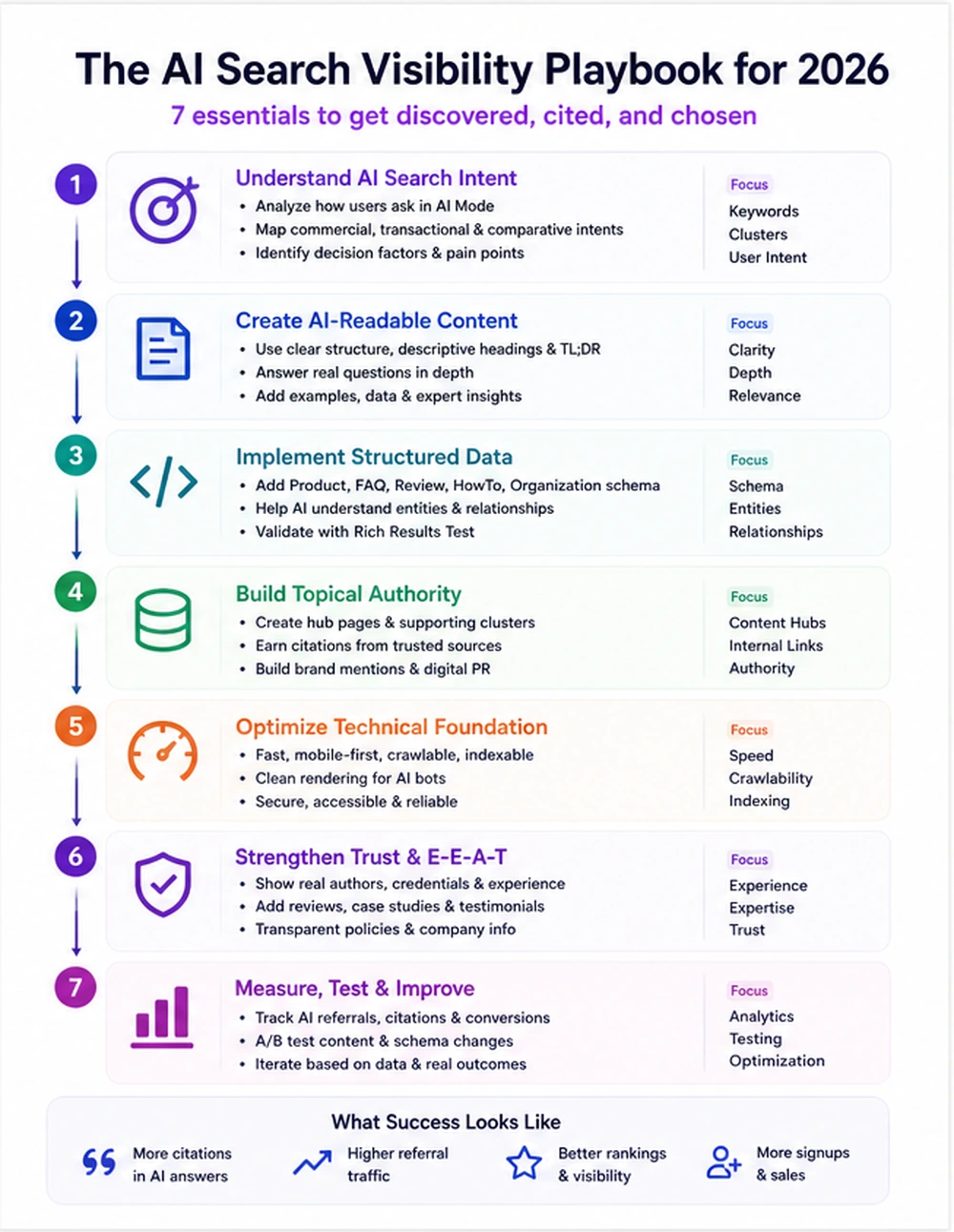
Use this checklist to evaluate whether an ecommerce or SaaS site is ready for AI-assisted discovery.
1. Crawlability and rendering
Important pages need to be crawlable, indexable, internally linked, and available in clean HTML. For JavaScript-heavy websites, confirm that titles, headings, body content, internal links, product details, pricing, and schema are available to search systems. Do not assume that a beautiful interface is automatically accessible.
2. Product or feature data quality
Ecommerce stores need complete product attributes, clean variant logic, accurate availability, high-quality images, and consistent feed data. SaaS sites need clear feature descriptions, use cases, integrations, security details, pricing factors, and implementation notes.
3. Structured data accuracy
Schema should match visible content. Validate product, organization, breadcrumb, FAQ, article, and review markup where relevant. Remove outdated or misleading markup. Keep product and feed data synchronized.
4. Page usefulness
Each important page should answer a full buyer question. A category page should help a shopper narrow options. A product page should help someone choose with confidence. A SaaS use-case page should clarify fit, process, proof, and next steps.
5. Internal links
Internal links should help users continue a decision. They should not exist only to pass authority. A buyer reading about AI automation should be able to move naturally to AI automation, relevant case studies, or related implementation guidance. Links should help the reader continue their decision.
6. Proof and trust
Add proof where decisions happen. Ecommerce proof includes reviews, policies, product media, comparison notes, shipping clarity, and customer support details. SaaS proof includes case studies, screenshots, workflow examples, integration lists, security notes, testimonials, and migration stories.
7. Performance and usability
Speed, mobile usability, layout stability, accessibility, and checkout or demo-form quality still matter. If a buyer lands from an AI-assisted result and the page is slow or confusing, visibility does not become revenue.
8. Measurement
Track landing pages, query growth, assisted conversions, form quality, checkout quality, referral traffic from AI tools where visible, sales notes, and revenue quality. Do not rely only on impressions. The real question is whether better visibility produces better buyers.
Ecommerce implementation priorities
Ecommerce teams should prioritize improvements in this order.
First, clean the catalog foundation. Fix duplicate products, missing attributes, variant confusion, weak product titles, inconsistent pricing, poor availability data, and thin descriptions. These issues affect SEO, ads, filters, merchandising, and customer experience at the same time.
Second, rebuild the product detail page template. A good product page should include the core description, use cases, specifications, variants, shipping and return context, reviews, FAQs, related products, and trust signals. Do not hide important details behind hard-to-use tabs or images.
Third, improve category pages. Category pages should not be empty grids. They should explain how to choose, which filters matter, how products differ, and where to start. For AI-assisted discovery, category pages can become useful evidence pages that connect buyer intent with product data.
Fourth, connect content to commerce. Buying guides, comparisons, FAQs, and product explainers should link to relevant category and product pages. This matters for human shoppers and for AI systems trying to understand the relationship between advice and inventory.
Fifth, improve performance and checkout. Visibility without conversion is waste. For WordPress and WooCommerce sites, performance work may include caching, image optimization, script cleanup, theme cleanup, database maintenance, and plugin reduction. When performance is the main bottleneck, WordPress speed optimization can produce more business value than another batch of articles.
Cuibit's B2B WooCommerce rebuild example is relevant because many ecommerce visibility problems are not isolated SEO problems. They involve catalog structure, user flows, performance, role-based buying needs, and maintainable store architecture.
SaaS implementation priorities
SaaS teams should start with the pages closest to revenue.
First, rewrite use-case pages around buyer situations. Do not only describe features. Explain who the use case is for, what problem it solves, which integrations matter, what setup requires, and what success looks like.
Second, build integration pages that are useful. A page for a CRM, analytics, messaging, or payment integration should explain what data moves, what permissions are needed, what actions are supported, what limitations exist, and how implementation usually works.
Third, create comparison content with editorial honesty. A comparison page should explain when your product is a fit and when another option may be better. This kind of honesty builds trust and helps buyers self-qualify.
Fourth, improve pricing logic. If exact pricing depends on usage, seats, implementation, or support, say so clearly. Buyers do not always need a fixed number, but they do need to understand the cost drivers.
Fifth, align the product site and the marketing site. If product reality and marketing claims do not match, AI-assisted buyers will notice. Documentation, help center content, feature pages, and sales pages should support the same story.
For SaaS companies building custom dashboards, marketplaces, portals, or product interfaces, Cuibit's AI development services and web engineering work often overlap. The strongest AI-powered products still need reliable user experience, permission models, data pipelines, analytics, and maintainable backend logic.
Agentic commerce: why readiness now affects future buying flows
Agentic commerce means AI systems increasingly help users complete buying tasks: researching, comparing, asking product questions, selecting options, and moving toward purchase. This does not mean every transaction becomes fully automated overnight. It does mean the information layer around products and services needs to be much more precise.
If an AI assistant is helping a shopper compare products, it needs reliable product attributes and policies. If it is helping a SaaS buyer shortlist tools, it needs clear use cases and proof. If it is helping a business evaluate vendors, it needs case studies, service descriptions, technical details, and trust signals.
Businesses that prepare now will have cleaner data, better pages, stronger measurement, and fewer gaps when agentic experiences become more common. Businesses that wait may discover that their website was built for an older search journey.
This is especially important for teams planning rebuilds. A redesign that only changes visuals will not solve the problem. A useful rebuild should improve content models, data quality, structured markup, performance, analytics, and conversion paths. Cuibit's case studies show how serious digital projects often combine design, engineering, performance, and business logic rather than treating the website as a surface-level asset.
What to avoid
Avoid publishing broad AI search articles that do not connect to your actual products, services, or buyer decisions. Generic content may create pages, but it does not create trust.
Avoid schema that exaggerates what the page provides. Structured data should support truth, not create a second version of the page for machines.
Avoid product pages with missing data. In ecommerce, thin catalog data weakens search, ads, filters, recommendations, and customer confidence.
Avoid SaaS pages that describe benefits without explaining implementation. Business buyers care about setup, adoption, risk, and proof.
Avoid rebuilding a site without fixing the content model. A new design on top of the same weak information architecture will not solve AI search visibility.
Avoid measuring only traffic. Track qualified actions, sales conversations, checkout quality, demo quality, assisted conversions, and revenue impact.
A 30-day action plan
In the first week, choose 10 revenue-critical pages. For ecommerce, include top categories and top products. For SaaS, include use-case pages, integration pages, pricing, comparison content, and high-converting landing pages.
In the second week, audit technical access and data quality. Check indexing, rendering, internal links, schema, performance, product feeds, page templates, and analytics.
In the third week, rewrite the pages that matter most. Add buyer questions, proof, comparison context, FAQs, policies, implementation details, product attributes, and stronger internal links.
In the fourth week, measure and improve. Watch Search Console trends, landing page engagement, checkout or demo quality, CRM notes, and revenue signals. Keep improving the pages based on what buyers actually ask.
For a larger rebuild, the same sequence still applies. Strategy first, then content models, then design, then engineering, then measurement. This order prevents teams from creating attractive pages that still fail to answer buyer intent.
Editorial conclusion
Google AI Mode and AI-assisted shopping do not make websites less important. They make weak websites easier to ignore.
Ecommerce companies need cleaner product data, better product pages, stronger category logic, accurate schema, and faster buying paths. SaaS companies need clearer use-case pages, integration detail, implementation guidance, pricing logic, proof, and comparison content. Both need technical foundations that make important information easy to crawl, understand, and act on.
The winners will not be the brands that chase every AI search phrase. They will be the brands that make their products, services, proof, and decisions easier for humans and AI systems to understand.
For business teams, the next step is practical: pick the pages that affect revenue, audit them honestly, improve the data and content behind them, and measure whether better visibility is creating better buyers. That is how AI search readiness turns from a trend into a business advantage.
Need this advice turned into a real delivery plan?
We can review your current stack, pressure-test the tradeoffs in this guide and turn it into a scoped implementation plan for your team.