Cuibit publishes insights from shipped delivery work across web, WordPress, AI and mobile. Articles are written for real buying and implementation decisions, then updated as the stack or the advice changes.
Cuibit WordPress Performance
WordPress and WooCommerce delivery team
The Cuibit team focused on custom WordPress builds, WooCommerce systems, Core Web Vitals and long-term maintainability.
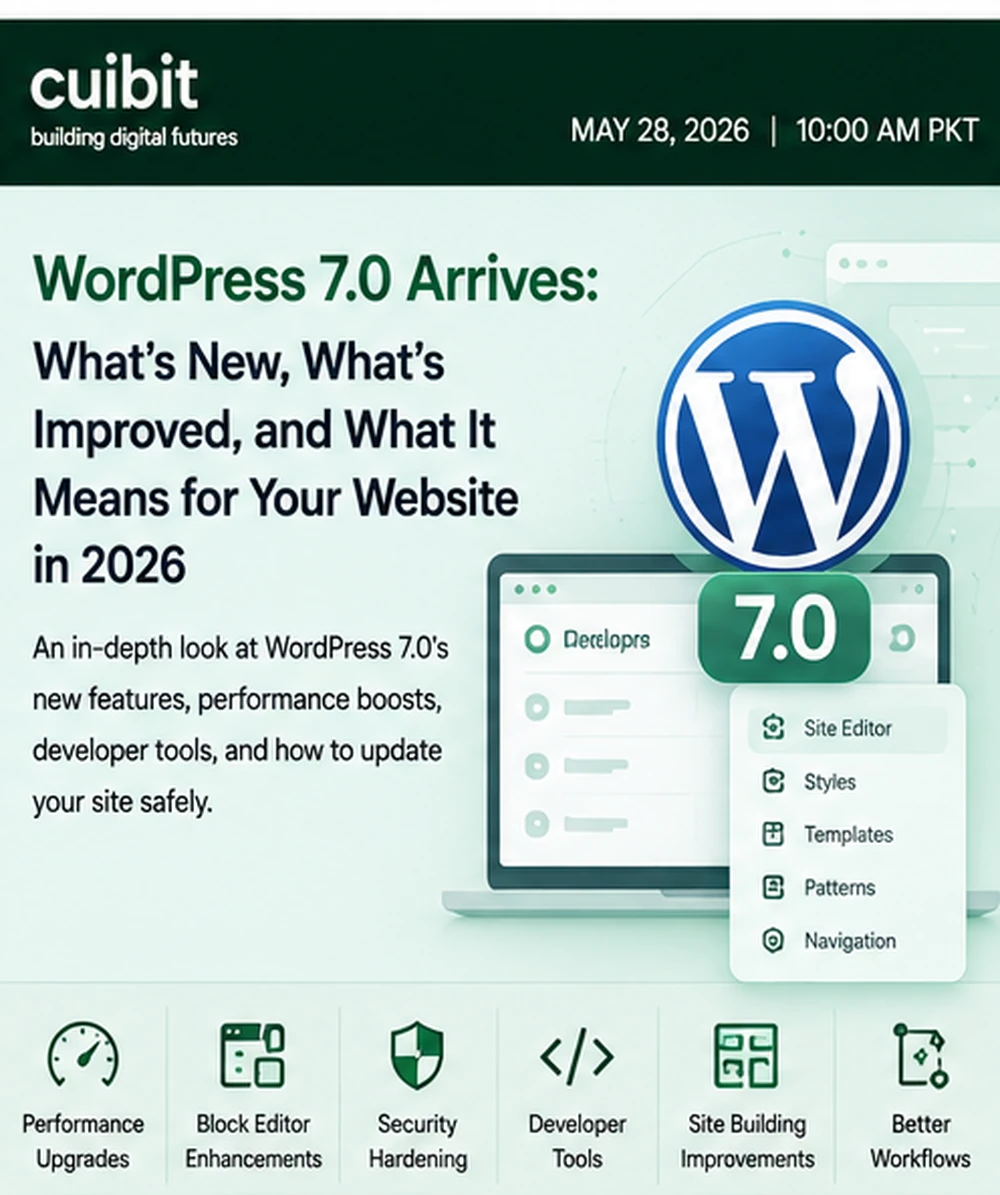
WordPress 7.0 Upgrade Guide: AI Foundations, Editor Changes, Performance, and Safe Rollout
WordPress 7.0 has arrived, so a WordPress 6.9 article is no longer the right editorial angle. The right question now is how business websites should update safely and use WordPress 7.0’s new foundations without creating production risk. The release brings visible editor and admin improvements, accessibility updates, modernized site-building experiences, and deeper foundations for AI-aware WordPress workflows.
For business teams, the update is not just a button in the dashboard. It affects plugins, custom blocks, WooCommerce, editor workflows, maintenance policies, performance budgets, and security assumptions. A careful rollout can improve the website. A rushed update can create avoidable downtime.
Key takeaways
- WordPress 7.0 is released and should replace any planned WordPress 6.9 coverage.
- Business sites should update through staging, not directly on production.
- The release improves editor, admin, accessibility, site-building, and developer foundations.
- WooCommerce and custom plugin sites need deeper compatibility testing.
- WordPress 7.0 is also a good moment to review AI, content, and performance readiness.
What WordPress 7.0 means for business websites
WordPress 7.0 is important because it sits at the intersection of editor experience, AI infrastructure, accessibility, and developer workflow. Site owners may notice cleaner admin experiences, editor improvements, block updates, visual polish, and usability improvements. Developers and agencies should pay attention to the deeper technical changes that affect how blocks, APIs, and tools interact with WordPress over time.
For a business, the value is practical. A better editor can reduce marketing bottlenecks. Better accessibility fixes can improve usability and compliance posture. Better development foundations can reduce future build friction. But none of that matters if the update breaks a custom plugin or checkout workflow.
Why staging is mandatory
Major WordPress releases should not be tested on live revenue websites. Create a staging copy that matches production closely. Update WordPress core, plugins, the theme, custom blocks, forms, SEO tools, caching, security plugins, and WooCommerce extensions. Test both the public pages and the admin workflows.
Business-critical sites should test login, forms, lead capture, editor permissions, media upload, search, menus, block patterns, payment gateways, product pages, cart, checkout, transactional emails, and scheduled jobs. The goal is not only to confirm that pages load. The goal is to confirm that the business can still operate.
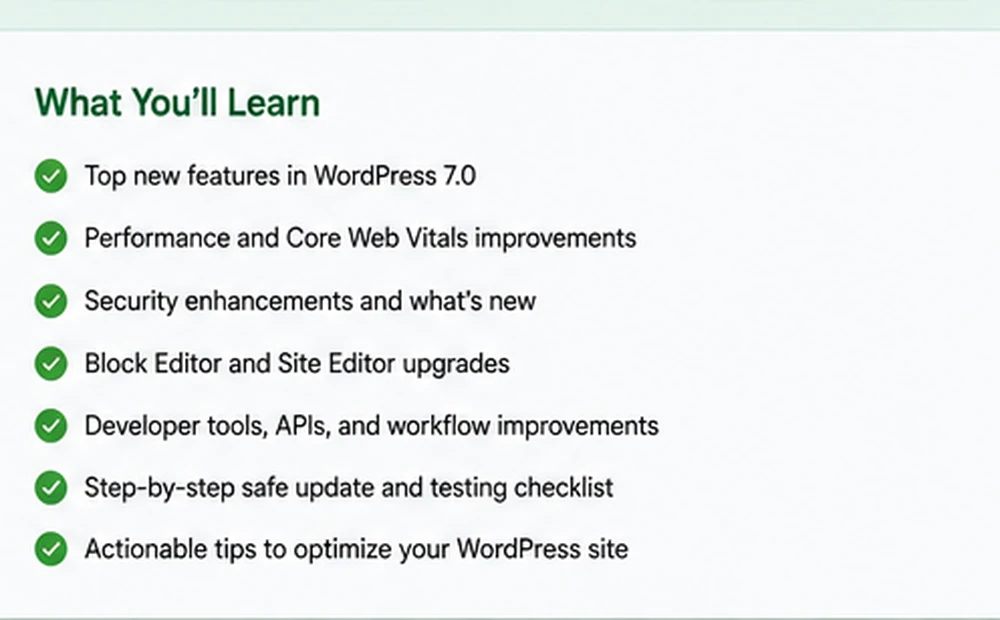
Audit custom blocks and editor workflows
WordPress 7.0 is a useful trigger to review custom blocks, reusable patterns, block styles, template parts, and editor permissions. Many older WordPress builds contain custom code added quickly during redesigns. Those pieces may still work, but they may not be easy to maintain.
Review whether editors can safely update service pages, case studies, landing pages, blog posts, and CTAs without developer help. A WordPress site is only valuable if the team can use it confidently. If editors avoid the CMS because it feels fragile, the site has a workflow problem, not only a design problem.
Use the update to clean technical debt
A major WordPress update is the right time to reduce plugin debt. Remove inactive plugins, replace abandoned tools, review builder dependencies, clean old snippets, and check whether custom code belongs in a child theme, a custom plugin, or a modern block.
This is especially important for companies using WordPress as a business platform rather than a brochure. Old code creates risk with every update. Cleaner architecture reduces future maintenance cost and makes performance work easier.
WooCommerce sites need deeper QA
WooCommerce stores should treat WordPress 7.0 as an ecommerce release event. Test products, variations, categories, coupons, cart behavior, checkout, payment methods, taxes, shipping, emails, refunds, customer accounts, subscriptions, and admin order management. Also check caching exclusions and background actions.
Cuibit’s WooCommerce development work often focuses on this practical layer: making sure business workflows survive updates, campaigns, plugin changes, and performance work.
Performance and AI-readiness after WordPress 7.0
WordPress 7.0 is also a good moment to review speed and AI-readiness. Check Core Web Vitals, render-blocking assets, image handling, schema, internal links, structured FAQs, and content quality. If the site has AI connectors or tools that store API credentials, review permissions and security controls carefully.
For teams building AI-assisted workflows, the safer path is to connect AI to approved content and controlled actions rather than giving broad access to production systems. Strong WordPress maintenance support should now include AI-tool governance.
A safe WordPress 7.0 rollout checklist
Back up production. Clone staging. Update PHP and dependencies where needed. Update WordPress core. Update plugins one group at a time. Test editor workflows. Test business-critical user journeys. Validate SEO settings, schema, redirects, caching, and forms. Check logs. Deploy during a low-risk window. Monitor for at least 48 hours.
If the site is already fragile, do not force the update. Stabilize the foundation first. Sometimes the update exposes the need for a rebuild, a maintenance retainer, or a focused performance sprint.
Editorial conclusion
WordPress 7.0 deserves a fresh article because it is now the current release. The strongest business angle is not hype; it is safe adoption. Update carefully, use the release to improve editor workflows, clean technical debt, test WooCommerce deeply, and strengthen the site for faster, more structured, AI-aware content operations.
For related Cuibit work, review WordPress development services custom WordPress development.
Additional operating notes
A practical implementation should include ownership, documentation, release monitoring, training, and post-launch review. Teams should track what changed, who approved it, how performance moved, and what risks remain. This makes the work maintainable after the article is published and helps the business avoid repeating the same technical debt.
Additional operating notes
A practical implementation should include ownership, documentation, release monitoring, training, and post-launch review. Teams should track what changed, who approved it, how performance moved, and what risks remain. This makes the work maintainable after the article is published and helps the business avoid repeating the same technical debt.
Additional operating notes
A practical implementation should include ownership, documentation, release monitoring, training, and post-launch review. Teams should track what changed, who approved it, how performance moved, and what risks remain. This makes the work maintainable after the article is published and helps the business avoid repeating the same technical debt.
Additional operating notes
A practical implementation should include ownership, documentation, release monitoring, training, and post-launch review. Teams should track what changed, who approved it, how performance moved, and what risks remain. This makes the work maintainable after the article is published and helps the business avoid repeating the same technical debt.
Additional operating notes
A practical implementation should include ownership, documentation, release monitoring, training, and post-launch review. Teams should track what changed, who approved it, how performance moved, and what risks remain. This makes the work maintainable after the article is published and helps the business avoid repeating the same technical debt.
Additional operating notes
A practical implementation should include ownership, documentation, release monitoring, training, and post-launch review. Teams should track what changed, who approved it, how performance moved, and what risks remain. This makes the work maintainable after the article is published and helps the business avoid repeating the same technical debt.
Additional operating notes
A practical implementation should include ownership, documentation, release monitoring, training, and post-launch review. Teams should track what changed, who approved it, how performance moved, and what risks remain. This makes the work maintainable after the article is published and helps the business avoid repeating the same technical debt.
Additional operating notes
A practical implementation should include ownership, documentation, release monitoring, training, and post-launch review. Teams should track what changed, who approved it, how performance moved, and what risks remain. This makes the work maintainable after the article is published and helps the business avoid repeating the same technical debt.
Additional operating notes
A practical implementation should include ownership, documentation, release monitoring, training, and post-launch review. Teams should track what changed, who approved it, how performance moved, and what risks remain. This makes the work maintainable after the article is published and helps the business avoid repeating the same technical debt.
Additional operating notes
A practical implementation should include ownership, documentation, release monitoring, training, and post-launch review. Teams should track what changed, who approved it, how performance moved, and what risks remain. This makes the work maintainable after the article is published and helps the business avoid repeating the same technical debt.
Additional operating notes
A practical implementation should include ownership, documentation, release monitoring, training, and post-launch review. Teams should track what changed, who approved it, how performance moved, and what risks remain. This makes the work maintainable after the article is published and helps the business avoid repeating the same technical debt.
Additional operating notes
A practical implementation should include ownership, documentation, release monitoring, training, and post-launch review. Teams should track what changed, who approved it, how performance moved, and what risks remain. This makes the work maintainable after the article is published and helps the business avoid repeating the same technical debt.
Additional operating notes
A practical implementation should include ownership, documentation, release monitoring, training, and post-launch review. Teams should track what changed, who approved it, how performance moved, and what risks remain. This makes the work maintainable after the article is published and helps the business avoid repeating the same technical debt.
Additional operating notes
A practical implementation should include ownership, documentation, release monitoring, training, and post-launch review. Teams should track what changed, who approved it, how performance moved, and what risks remain. This makes the work maintainable after the article is published and helps the business avoid repeating the same technical debt.
Additional operating notes
A practical implementation should include ownership, documentation, release monitoring, training, and post-launch review. Teams should track what changed, who approved it, how performance moved, and what risks remain. This makes the work maintainable after the article is published and helps the business avoid repeating the same technical debt.
Additional operating notes
A practical implementation should include ownership, documentation, release monitoring, training, and post-launch review. Teams should track what changed, who approved it, how performance moved, and what risks remain. This makes the work maintainable after the article is published and helps the business avoid repeating the same technical debt.
Additional operating notes
A practical implementation should include ownership, documentation, release monitoring, training, and post-launch review. Teams should track what changed, who approved it, how performance moved, and what risks remain. This makes the work maintainable after the article is published and helps the business avoid repeating the same technical debt.
Additional operating notes
A practical implementation should include ownership, documentation, release monitoring, training, and post-launch review. Teams should track what changed, who approved it, how performance moved, and what risks remain. This makes the work maintainable after the article is published and helps the business avoid repeating the same technical debt.
Additional operating notes
A practical implementation should include ownership, documentation, release monitoring, training, and post-launch review. Teams should track what changed, who approved it, how performance moved, and what risks remain. This makes the work maintainable after the article is published and helps the business avoid repeating the same technical debt.
Additional operating notes
A practical implementation should include ownership, documentation, release monitoring, training, and post-launch review. Teams should track what changed, who approved it, how performance moved, and what risks remain. This makes the work maintainable after the article is published and helps the business avoid repeating the same technical debt.
Additional operating notes
A practical implementation should include ownership, documentation, release monitoring, training, and post-launch review. Teams should track what changed, who approved it, how performance moved, and what risks remain. This makes the work maintainable after the article is published and helps the business avoid repeating the same technical debt.
Additional operating notes
A practical implementation should include ownership, documentation, release monitoring, training, and post-launch review. Teams should track what changed, who approved it, how performance moved, and what risks remain. This makes the work maintainable after the article is published and helps the business avoid repeating the same technical debt.
Additional operating notes
A practical implementation should include ownership, documentation, release monitoring, training, and post-launch review. Teams should track what changed, who approved it, how performance moved, and what risks remain. This makes the work maintainable after the article is published and helps the business avoid repeating the same technical debt.
Additional operating notes
A practical implementation should include ownership, documentation, release monitoring, training, and post-launch review. Teams should track what changed, who approved it, how performance moved, and what risks remain. This makes the work maintainable after the article is published and helps the business avoid repeating the same technical debt.
Additional operating notes
A practical implementation should include ownership, documentation, release monitoring, training, and post-launch review. Teams should track what changed, who approved it, how performance moved, and what risks remain. This makes the work maintainable after the article is published and helps the business avoid repeating the same technical debt.
Additional operating notes
A practical implementation should include ownership, documentation, release monitoring, training, and post-launch review. Teams should track what changed, who approved it, how performance moved, and what risks remain. This makes the work maintainable after the article is published and helps the business avoid repeating the same technical debt.
Additional operating notes
A practical implementation should include ownership, documentation, release monitoring, training, and post-launch review. Teams should track what changed, who approved it, how performance moved, and what risks remain. This makes the work maintainable after the article is published and helps the business avoid repeating the same technical debt.
Additional operating notes
A practical implementation should include ownership, documentation, release monitoring, training, and post-launch review. Teams should track what changed, who approved it, how performance moved, and what risks remain. This makes the work maintainable after the article is published and helps the business avoid repeating the same technical debt.
Additional operating notes
A practical implementation should include ownership, documentation, release monitoring, training, and post-launch review. Teams should track what changed, who approved it, how performance moved, and what risks remain. This makes the work maintainable after the article is published and helps the business avoid repeating the same technical debt.
Additional operating notes
A practical implementation should include ownership, documentation, release monitoring, training, and post-launch review. Teams should track what changed, who approved it, how performance moved, and what risks remain. This makes the work maintainable after the article is published and helps the business avoid repeating the same technical debt.
Additional operating notes
A practical implementation should include ownership, documentation, release monitoring, training, and post-launch review. Teams should track what changed, who approved it, how performance moved, and what risks remain. This makes the work maintainable after the article is published and helps the business avoid repeating the same technical debt.
Additional operating notes
A practical implementation should include ownership, documentation, release monitoring, training, and post-launch review. Teams should track what changed, who approved it, how performance moved, and what risks remain. This makes the work maintainable after the article is published and helps the business avoid repeating the same technical debt.
Need this advice turned into a real delivery plan?
We can review your current stack, pressure-test the tradeoffs in this guide and turn it into a scoped implementation plan for your team.