Cuibit publishes insights from shipped delivery work across web, WordPress, AI and mobile. Articles are written for real buying and implementation decisions, then updated as the stack or the advice changes.
Cuibit AI Systems
Applied AI and LLM delivery team
The Cuibit team focused on production RAG, LLM integration, workflow automation, evaluation and model cost control.
Key takeaways
- Google's May 2026 core update finished rolling out on June 2 after roughly 12 days, and the rollout produced meaningful ranking volatility across many sectors.
- Google announced dedicated generative AI performance reports on June 3, 2026 and states that the insights rolled out worldwide by August 31. Inspect the reports actually available for the property rather than assuming it remains a selected-UK-site test.
- Businesses should not respond by rewriting every page or publishing generic AI content. The safe response is a structured audit that separates traffic noise from real ranking, lead-quality, content, and technical issues.
- The highest-value work sits between technical SEO, content strategy, web engineering, analytics, and AI-search measurement.
- A recovery plan should start with data stabilization, then move through visibility diagnosis, page-quality review, technical crawl checks, schema review, internal linking, Core Web Vitals, and ongoing reporting.
Why this matters now
Most AI-search articles tell businesses to optimize for AI answers without explaining what to measure or what to change. That advice is too vague after a core update. When rankings move, AI Overviews expand, and Search Console begins testing AI-specific visibility reports, teams need a practical operating model.
The May 2026 core update created that moment. Search Engine Land reported that the update began on May 21 and finished on June 2. Search Engine Journal described the rollout as volatile and noted that Google recommends waiting before judging results. At nearly the same time, Google began testing Search Generative AI performance reports and AI visibility controls in Search Console for selected UK site owners. Those reports matter because they address the measurement gap that businesses already feel: visibility in AI Overviews, AI Mode, and generative search experiences is not the same as traditional ranking visibility.
For Cuibit, this topic belongs at the intersection of AI search visibility auditing, web development services, technical SEO, analytics architecture, and content quality. Businesses do not need a panic rewrite. They need a clean measurement model and a practical recovery workflow.
Step 1: wait long enough before judging the update
The first mistake after any core update is reacting too early. During rollout, rankings move, tracking tools spike, and teams often mistake temporary volatility for permanent loss. A business should wait until the rollout is complete, then give data enough time to settle before deciding what actually changed.
A practical review window is usually seven to fourteen days after completion. Compare that period with the same weekday pattern before the update, not only the previous week. If traffic is seasonal, compare with the closest relevant period from the prior year. Separate brand demand from non-brand discovery. Segment pages by intent: service pages, location pages, blog posts, comparison articles, portfolio pages, product pages, and landing pages.
The goal is to identify patterns, not individual noisy URLs. A single page dropping for one query may not mean much. A whole cluster of service pages losing non-brand impressions across commercial terms is a business issue. A blog cluster losing traffic but generating no leads may be lower priority. A comparison page losing rankings for buyer-intent queries may require immediate review.
Step 2: separate traditional search data from AI-search visibility
Google's new generative-AI reporting tests matter because businesses have been trying to infer AI visibility from indirect signals. AI Overviews and AI Mode can change the search journey even when the organic listing still exists. A page may receive fewer clicks despite stable impressions. Another page may be cited in AI answers but not rank where the team expects. A brand may be described inaccurately even when its own site ranks.
Until reporting is widely available, use a blended measurement model: Search Console impressions and clicks by query group, rank tracking for priority commercial terms, manual AI Overview checks, referral traffic from visible AI tools, brand-mention monitoring, lead quality by landing page, and content freshness review for pages that lost visibility.
This is where SEO, GEO, and AEO stop being labels and become reporting layers. SEO still matters. AI-answer visibility matters. The answerability of content matters. They overlap but should not be measured as one number.
Step 3: diagnose page groups, not random URLs
Core-update recovery should be organized by page type. Service-business websites usually have several different content systems, and each fails in a different way.
Service pages should clearly explain who the service is for, what the engagement includes, what tradeoffs exist, what technology choices matter, and what proof the company has. Thin service pages with generic claims are vulnerable because they do not show enough real expertise.
Cuibit service categories such as custom web development, WordPress development services, and AI development services should be reviewed through buyer intent, scope, outcomes, risks, process, and evidence.
Comparison pages should help buyers make decisions. Strong comparison content includes use cases, cost logic, implementation risks, decision rules, and honest tradeoffs. Case studies and portfolio pages should provide evidence. Cuibit's custom React enterprise dashboard and backend reliability rebuild portfolio examples illustrate how project context, architecture, constraints, and outcomes can support expertise signals.
Step 4: run a technical SEO floor check
Content quality and technical quality should be reviewed together. A useful page can still underperform if the technical floor is weak. Check indexability, canonical tags, sitemap inclusion, internal links, broken links, redirect chains, structured data, duplicate titles, mobile rendering, Core Web Vitals, server response time, JavaScript rendering, image weight, crawl depth, pagination, and filter handling.
Technical SEO is not separate from AI search. Generative systems still need accessible source pages. If a page is slow, hard to crawl, poorly structured, or internally isolated, it is less likely to become a reliable source for search systems.
Step 5: strengthen entity clarity
Many brands are poorly described across the web because their own sites are not clear enough. AI systems form summaries from many signals. Your website should make the basics obvious: what the company does, which industries it serves, which technologies it specializes in, which services are primary, what proof supports the claims, and who is behind the content.
For a B2B technology website, entity clarity means connecting service pages, case studies, author profiles, FAQs, comparison pages, and technical guides. A reader and a search system should both understand the company's work across Next.js development, RAG development, WordPress, WooCommerce, SaaS, and mobile engineering without having to infer it from scattered pages.
Step 6: build an update-recovery dashboard
A practical dashboard should show organic clicks and impressions by page type, non-brand commercial query movement, lead volume and lead quality by landing page, AI-search visibility checks for priority queries, pages with visibility loss but high business value, technical issues fixed, content sections added, internal links added, schema changes, and conversion movement after updates.
Do not measure recovery only by traffic. Some traffic is low-value. A technical article may lose impressions but keep qualified leads. A service page may lose clicks but improve conversion rate. A visibility recovery process should measure business outcomes, not only SEO graphs.
Step 7: improve pages with evidence, not filler
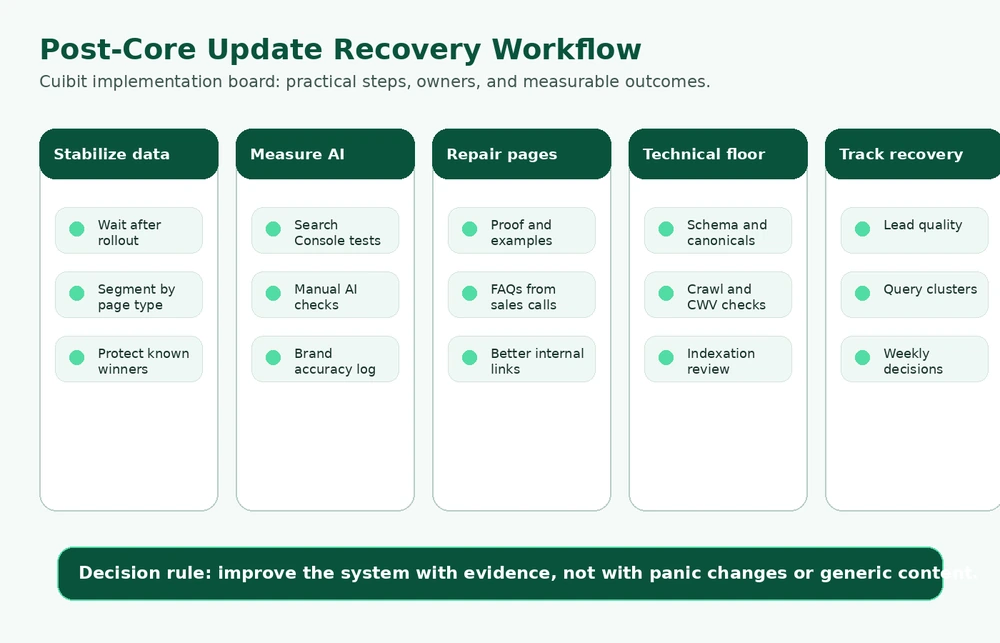
The worst response to a core update is mass publishing. If pages are weak, improve them carefully. Add useful details: what the service includes, what it does not include, when the solution is a poor fit, common implementation risks, real examples, pricing logic where appropriate, technical architecture choices, buyer checklists, FAQs based on sales calls, and internal links to proof pages.
For example, a page about LLM integration services should not only say that the company integrates AI. It should explain data boundaries, model selection, retrieval patterns, security, evaluation, fallback handling, and maintenance. That is the kind of content that helps humans and gives AI-search systems clearer source material.
Step 8: refresh internal linking around business priorities
Internal links should not be random. After a core update, review whether high-value service pages receive enough contextual links from relevant articles, case studies, and comparison pages. Strong internal linking helps users move from education to decision and helps crawlers understand which pages matter.
Prioritize links from high-performing articles to matching service pages, case studies to related services, service pages to relevant portfolio examples, comparison pages to buyer next steps, and technical guides to deeper implementation pages. Avoid linking every service page from every article. That dilutes intent.
Step 9: decide what not to change
Core-update recovery also requires restraint. Do not rewrite pages that are stable and converting. Do not remove useful sections because a ranking tool moved temporarily. Do not chase every AI-search tactic. Do not add schema that does not match visible content. Do not remove technical depth because a page is long. Do not publish twenty thin articles when five strong updates would be more useful.
A 30-day recovery plan
Week one is measurement and segmentation. Wait for rollout stabilization. Segment data by page type, query intent, brand versus non-brand, and conversion role. Capture AI-search visibility snapshots.
Week two is technical floor and content diagnostics. Run crawl checks, Core Web Vitals review, schema validation, indexability checks, and content-quality review for affected clusters.
Week three is page improvement. Update priority pages with better evidence, structure, internal links, FAQs, examples, author context, and clearer decision support.
Week four is monitoring and governance. Track recovery, lead quality, AI-search appearances, and technical fixes. Create an editorial standard so future pages do not repeat the same weaknesses.
How engineering and content teams should work together
A recovery process usually fails when the SEO team writes a content brief, the developer fixes a few technical errors, and nobody owns the complete outcome. In 2026, the work needs shared ownership. Developers should understand which templates and rendering choices affect crawlability. Content teams should understand how structure, proof, and internal links affect discovery. Leadership should understand that recovery is not a one-day fix.
The most useful operating model is a weekly visibility review. Bring analytics, Search Console, page-level changes, technical tickets, and conversion outcomes into one meeting. Decide what to fix next based on business value and evidence. This prevents the team from chasing every small ranking movement and keeps focus on revenue-relevant improvements.
Editorial conclusion
The May 2026 core update and Google's AI-search reporting tests are a reminder that search visibility is becoming more complex, not less. Businesses cannot rely on old ranking reports alone. They need a wider view of visibility, usefulness, technical accessibility, and commercial outcomes.
The practical response is not panic. It is a structured audit. Measure carefully, diagnose by page type, improve what is weak, protect what works, and build a website that deserves to be used as a source. That is what durable SEO and AI-search readiness now require: clear expertise, strong technical foundations, helpful content, and measurement that reflects how people discover and evaluate businesses in 2026.
Sources and scope
Platform behavior can change. Check the documentation for the version and account you use. Recommendations in this guide do not guarantee a ranking, performance gain, compliance outcome or project result.
Need this advice turned into a real delivery plan?
We can review your current stack, pressure-test the tradeoffs in this guide and turn it into a scoped implementation plan for your team.