Cuibit publishes insights from shipped delivery work across web, WordPress, AI and mobile. Articles are written for real buying and implementation decisions, then updated as the stack or the advice changes.
Cuibit AI Systems
Applied AI and LLM delivery team
The Cuibit team focused on production RAG, LLM integration, workflow automation, evaluation and model cost control.

Google AI Search Policy and Visibility Strategy for Business Websites in 2026
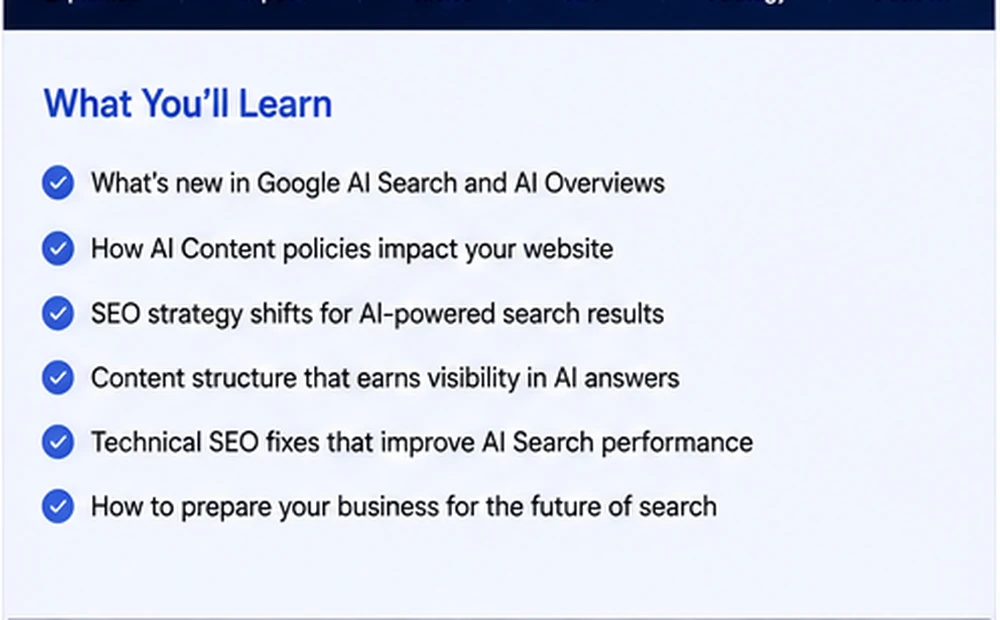
Google’s AI Search changes are no longer a future-facing SEO topic. AI Mode, AI Overviews, source panels, follow-up journeys, and Google’s clarified spam policies for generative AI responses have changed how business websites should think about visibility. The practical lesson is not to chase shortcuts. The lesson is to make your website easier to understand, verify, cite, crawl, and trust.
For service businesses, SaaS companies, ecommerce brands, and technology teams, the biggest risk is creating generic AI content that looks scalable but fails to show experience. A strong AI-search strategy is closer to product documentation than old keyword publishing. It needs clear entities, strong internal links, first-hand examples, structured pages, reliable schema, fast templates, and content that answers real buyer questions.
Key takeaways
- Google’s generative AI search features reward clarity, source quality, and useful structure rather than manipulative AI-output tactics.
- Spam policies apply across Search, including generative AI responses, so low-value scaled content creates risk.
- AI Mode changes search behavior because users ask longer follow-up questions and compare answers before clicking.
- B2B websites should strengthen service pages, case studies, comparison pages, FAQs, and original expertise signals.
- Technical SEO still matters because AI systems need crawlable, fast, structured source pages.
What changed in search behavior
Traditional search journeys often started with short keywords and ended with a click to a page. AI Mode encourages longer, conversational queries and follow-up exploration. Users may compare vendors, ask for pricing context, request tradeoffs, or ask what to check before buying. That means a business website needs to support deeper research journeys, not only rank for a single phrase.
Your content should answer the questions buyers ask before a sales call. What does the service include? What are the risks? What should a buyer prepare? What does implementation look like? What should not be automated? Which platform is better for which use case? These are not filler questions. They are the substance that helps a page become useful enough to be cited or remembered.
Why spam-policy clarity matters
Google’s documentation now clarifies that spam policies also apply to generative AI features in Search. That matters because some brands are tempted to flood sites with machine-written pages that target every possible query. The safer path is the opposite: publish fewer, stronger pages with specific examples, technical substance, and clear business judgment.
Scaled content without original value can hurt trust. A service page built from real project patterns, implementation notes, pitfalls, and decision criteria is much stronger than a generic “best solution” article. This is where Cuibit’s approach to appearing in AI-generated answers without generic AI content becomes relevant.
Build pages that AI systems can parse
AI-search-ready content should be easy for machines and humans to extract. Use descriptive headings, concise explanations, tables where comparison helps, real FAQs, examples, structured data, and logical internal links. Avoid vague claims. If a page says you are expert at a service, show the process, scope, risks, and proof.
This is not only writing work. Page speed, HTML structure, schema, canonical rules, and crawlability matter. AI systems still depend on underlying web content. If your page is hidden behind client-side rendering, duplicated across many URLs, or slow to load, it becomes harder to trust.
Service pages need stronger decision support
Many B2B service pages are too thin. They describe benefits but fail to help the buyer decide. In AI search, that weakness becomes more visible. A strong service page should explain the problem, who the service is for, what is included, what is excluded, pricing logic, timelines, risks, onboarding, technical requirements, and common mistakes.
This applies across AI, web development, WordPress, SaaS engineering, and mobile apps. The best pages feel like a senior consultant explaining the work honestly. They do not hide tradeoffs. They help buyers avoid the wrong scope.
Use internal links as entity signals
Internal links are not decoration. They show how topics, services, examples, and proof connect. A page about AI search should link naturally to RAG development, LLM integration services, and practical guides about retrieval-ready content where those ideas support the reader.
A good internal link structure helps users move from education to evaluation. It also helps search systems understand the relationship between Cuibit’s services, insights, and portfolio proof.
A 30-day AI-search cleanup plan
Week one: audit service pages, top articles, case studies, schema, speed, internal links, and Search Console performance. Week two: rewrite thin pages with decision support and original analysis. Week three: improve structure, FAQs, comparison blocks, and source clarity. Week four: monitor rankings, impressions, AI-feature appearance where visible, and conversions.
Do not treat this as a one-time campaign. AI search will keep changing. The durable advantage is a site that stays useful, structured, and technically clean.
Editorial conclusion
Google AI Search does not eliminate SEO. It raises the standard. Businesses that publish clear, useful, experience-based content on technically strong pages will be better prepared than businesses chasing shortcuts. The safest strategy is to make your website worthy of being used as a source.
For related Cuibit work, review AI search visibility audit content retrieval readiness.
Additional operating notes
A practical implementation should include ownership, documentation, release monitoring, training, and post-launch review. Teams should track what changed, who approved it, how performance moved, and what risks remain. This makes the work maintainable after the article is published and helps the business avoid repeating the same technical debt.
Additional operating notes
A practical implementation should include ownership, documentation, release monitoring, training, and post-launch review. Teams should track what changed, who approved it, how performance moved, and what risks remain. This makes the work maintainable after the article is published and helps the business avoid repeating the same technical debt.
Additional operating notes
A practical implementation should include ownership, documentation, release monitoring, training, and post-launch review. Teams should track what changed, who approved it, how performance moved, and what risks remain. This makes the work maintainable after the article is published and helps the business avoid repeating the same technical debt.
Additional operating notes
A practical implementation should include ownership, documentation, release monitoring, training, and post-launch review. Teams should track what changed, who approved it, how performance moved, and what risks remain. This makes the work maintainable after the article is published and helps the business avoid repeating the same technical debt.
Additional operating notes
A practical implementation should include ownership, documentation, release monitoring, training, and post-launch review. Teams should track what changed, who approved it, how performance moved, and what risks remain. This makes the work maintainable after the article is published and helps the business avoid repeating the same technical debt.
Additional operating notes
A practical implementation should include ownership, documentation, release monitoring, training, and post-launch review. Teams should track what changed, who approved it, how performance moved, and what risks remain. This makes the work maintainable after the article is published and helps the business avoid repeating the same technical debt.
Additional operating notes
A practical implementation should include ownership, documentation, release monitoring, training, and post-launch review. Teams should track what changed, who approved it, how performance moved, and what risks remain. This makes the work maintainable after the article is published and helps the business avoid repeating the same technical debt.
Additional operating notes
A practical implementation should include ownership, documentation, release monitoring, training, and post-launch review. Teams should track what changed, who approved it, how performance moved, and what risks remain. This makes the work maintainable after the article is published and helps the business avoid repeating the same technical debt.
Additional operating notes
A practical implementation should include ownership, documentation, release monitoring, training, and post-launch review. Teams should track what changed, who approved it, how performance moved, and what risks remain. This makes the work maintainable after the article is published and helps the business avoid repeating the same technical debt.
Additional operating notes
A practical implementation should include ownership, documentation, release monitoring, training, and post-launch review. Teams should track what changed, who approved it, how performance moved, and what risks remain. This makes the work maintainable after the article is published and helps the business avoid repeating the same technical debt.
Additional operating notes
A practical implementation should include ownership, documentation, release monitoring, training, and post-launch review. Teams should track what changed, who approved it, how performance moved, and what risks remain. This makes the work maintainable after the article is published and helps the business avoid repeating the same technical debt.
Additional operating notes
A practical implementation should include ownership, documentation, release monitoring, training, and post-launch review. Teams should track what changed, who approved it, how performance moved, and what risks remain. This makes the work maintainable after the article is published and helps the business avoid repeating the same technical debt.
Additional operating notes
A practical implementation should include ownership, documentation, release monitoring, training, and post-launch review. Teams should track what changed, who approved it, how performance moved, and what risks remain. This makes the work maintainable after the article is published and helps the business avoid repeating the same technical debt.
Additional operating notes
A practical implementation should include ownership, documentation, release monitoring, training, and post-launch review. Teams should track what changed, who approved it, how performance moved, and what risks remain. This makes the work maintainable after the article is published and helps the business avoid repeating the same technical debt.
Additional operating notes
A practical implementation should include ownership, documentation, release monitoring, training, and post-launch review. Teams should track what changed, who approved it, how performance moved, and what risks remain. This makes the work maintainable after the article is published and helps the business avoid repeating the same technical debt.
Additional operating notes
A practical implementation should include ownership, documentation, release monitoring, training, and post-launch review. Teams should track what changed, who approved it, how performance moved, and what risks remain. This makes the work maintainable after the article is published and helps the business avoid repeating the same technical debt.
Additional operating notes
A practical implementation should include ownership, documentation, release monitoring, training, and post-launch review. Teams should track what changed, who approved it, how performance moved, and what risks remain. This makes the work maintainable after the article is published and helps the business avoid repeating the same technical debt.
Additional operating notes
A practical implementation should include ownership, documentation, release monitoring, training, and post-launch review. Teams should track what changed, who approved it, how performance moved, and what risks remain. This makes the work maintainable after the article is published and helps the business avoid repeating the same technical debt.
Additional operating notes
A practical implementation should include ownership, documentation, release monitoring, training, and post-launch review. Teams should track what changed, who approved it, how performance moved, and what risks remain. This makes the work maintainable after the article is published and helps the business avoid repeating the same technical debt.
Additional operating notes
A practical implementation should include ownership, documentation, release monitoring, training, and post-launch review. Teams should track what changed, who approved it, how performance moved, and what risks remain. This makes the work maintainable after the article is published and helps the business avoid repeating the same technical debt.
Additional operating notes
A practical implementation should include ownership, documentation, release monitoring, training, and post-launch review. Teams should track what changed, who approved it, how performance moved, and what risks remain. This makes the work maintainable after the article is published and helps the business avoid repeating the same technical debt.
Additional operating notes
A practical implementation should include ownership, documentation, release monitoring, training, and post-launch review. Teams should track what changed, who approved it, how performance moved, and what risks remain. This makes the work maintainable after the article is published and helps the business avoid repeating the same technical debt.
Additional operating notes
A practical implementation should include ownership, documentation, release monitoring, training, and post-launch review. Teams should track what changed, who approved it, how performance moved, and what risks remain. This makes the work maintainable after the article is published and helps the business avoid repeating the same technical debt.
Additional operating notes
A practical implementation should include ownership, documentation, release monitoring, training, and post-launch review. Teams should track what changed, who approved it, how performance moved, and what risks remain. This makes the work maintainable after the article is published and helps the business avoid repeating the same technical debt.
Additional operating notes
A practical implementation should include ownership, documentation, release monitoring, training, and post-launch review. Teams should track what changed, who approved it, how performance moved, and what risks remain. This makes the work maintainable after the article is published and helps the business avoid repeating the same technical debt.
Additional operating notes
A practical implementation should include ownership, documentation, release monitoring, training, and post-launch review. Teams should track what changed, who approved it, how performance moved, and what risks remain. This makes the work maintainable after the article is published and helps the business avoid repeating the same technical debt.
Additional operating notes
A practical implementation should include ownership, documentation, release monitoring, training, and post-launch review. Teams should track what changed, who approved it, how performance moved, and what risks remain. This makes the work maintainable after the article is published and helps the business avoid repeating the same technical debt.
Additional operating notes
A practical implementation should include ownership, documentation, release monitoring, training, and post-launch review. Teams should track what changed, who approved it, how performance moved, and what risks remain. This makes the work maintainable after the article is published and helps the business avoid repeating the same technical debt.
Additional operating notes
A practical implementation should include ownership, documentation, release monitoring, training, and post-launch review. Teams should track what changed, who approved it, how performance moved, and what risks remain. This makes the work maintainable after the article is published and helps the business avoid repeating the same technical debt.
Additional operating notes
A practical implementation should include ownership, documentation, release monitoring, training, and post-launch review. Teams should track what changed, who approved it, how performance moved, and what risks remain. This makes the work maintainable after the article is published and helps the business avoid repeating the same technical debt.
Additional operating notes
A practical implementation should include ownership, documentation, release monitoring, training, and post-launch review. Teams should track what changed, who approved it, how performance moved, and what risks remain. This makes the work maintainable after the article is published and helps the business avoid repeating the same technical debt.
Additional operating notes
A practical implementation should include ownership, documentation, release monitoring, training, and post-launch review. Teams should track what changed, who approved it, how performance moved, and what risks remain. This makes the work maintainable after the article is published and helps the business avoid repeating the same technical debt.
Additional operating notes
A practical implementation should include ownership, documentation, release monitoring, training, and post-launch review. Teams should track what changed, who approved it, how performance moved, and what risks remain. This makes the work maintainable after the article is published and helps the business avoid repeating the same technical debt.
Need this advice turned into a real delivery plan?
We can review your current stack, pressure-test the tradeoffs in this guide and turn it into a scoped implementation plan for your team.