Cuibit publishes insights from shipped delivery work across web, WordPress, AI and mobile. Articles are written for real buying and implementation decisions, then updated as the stack or the advice changes.
Direct answer: what should you look for in an AI development agency in 2026?
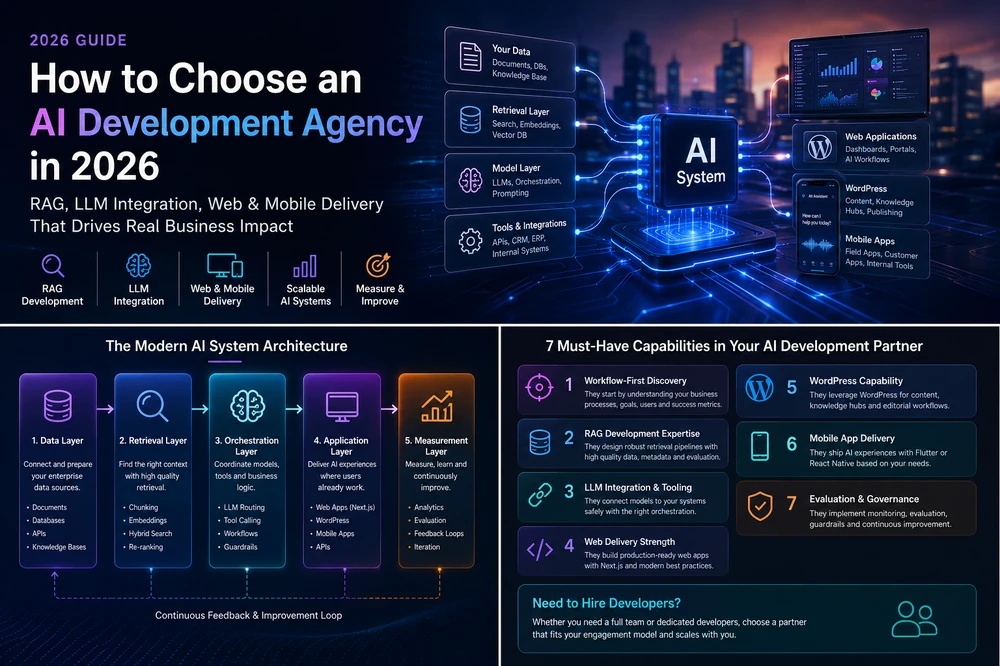
You should choose an AI development agency that can do four things well: design reliable retrieval and tool-access architecture, integrate large language models with your real business systems, ship the product layer where people actually use AI, and measure the system after launch. In practice, that means the right partner should handle RAG development, LLM integration, admin workflows, permissions, analytics, evaluation, and the surrounding user experience in web or mobile products.
If an agency only shows polished chatbot demos, it is not enough. Production AI now lives inside CRMs, support desks, internal knowledge systems, content pipelines, field workflows, and customer portals. That is why many companies no longer need a model vendor alone. They need a delivery partner that can connect models, data, tools, interfaces, and business logic into one usable system.
For most organizations, the best partner is not just an AI specialist in isolation. It is a team that can also act as a web development company, deliver next.js development for dashboards and portals, support wordpress development for content-heavy workflows, and extend the experience into mobile app development when employees or customers need AI on the go.
Why this decision changed in 2026
The agency selection process changed because AI products changed. Last year, many teams still talked mainly about prompts. Today, serious AI delivery is about context, retrieval, tool connections, orchestration, and interface design. Businesses want agents that can search approved content, call internal tools, reason over large document sets, and return answers inside real software instead of isolated chat windows.
That shift matters because it changes what “good implementation” looks like. A strong agency now needs to think in systems: source-of-truth data, ingestion, vector or search retrieval, model routing, tool permissions, fallback behavior, monitoring, evaluation, and user-facing delivery. If they cannot explain those layers clearly, they are not ready for production-grade work.
It also means architecture choices are more nuanced than “use the biggest model.” Long context is useful, but it does not eliminate the need for retrieval. Tool calling is powerful, but only when permissions and outputs are designed carefully. Agents can automate more, but only if the surrounding product and governance are solid. The best agencies understand those tradeoffs and design for your actual workflow instead of pushing one fashionable stack onto every project.
The 7 capabilities your agency should have
1. Discovery that starts from workflows, not hype
A mature partner begins by mapping the work: who needs AI, what decisions they make, which systems they use, what content is trusted, what failure looks like, and what success should be measured against. This matters more than a model comparison spreadsheet.
Ask them to define the specific operating loop. For example: ingest approved documents, retrieve the most relevant passages, call CRM data for account context, generate a draft response, require human approval, and log the decision. If they cannot turn your use case into a clear step-by-step loop, they are not ready to build it.
2. Proven RAG development capability
RAG development should be a real engineering practice, not a keyword in a proposal. Your agency should be able to explain document ingestion, chunking strategy, metadata design, retrieval quality, permission handling, freshness rules, and evaluation. They should know when semantic retrieval is enough, when keyword signals still matter, and when a hybrid approach is safer.
Good retrieval design is often what separates a useful AI assistant from an expensive liability. Many failures that look like “model problems” are actually data access problems: stale sources, poor chunking, weak metadata, no ranking layer, or no source attribution.
3. Strong LLM integration, not just model access
LLM integration means connecting models to the rest of your business stack. That includes identity, APIs, storage, search, business rules, analytics, human review, and fallback workflows. If the agency cannot discuss how model outputs move through your product and operations, they are selling experimentation, not delivery.
A good implementation partner will also help with practical questions such as model routing, latency budgets, streaming responses, safe tool execution, structured outputs, retries, audit trails, and deployment constraints. This is often where value is won or lost.
4. Product delivery on the web layer
AI is only useful when people can actually use it. That is why the best AI partner often overlaps with a capable web development company. Many companies need AI embedded into portals, internal systems, partner dashboards, search experiences, workflow builders, or content operations tools.
For product teams that need a fast, scalable application layer, next.js development is often the right choice. It works especially well for authenticated dashboards, admin panels, search-heavy interfaces, and AI-powered web applications where performance, caching, and modern frontend patterns matter.
For businesses where content governance, editorial workflows, landing pages, or marketing operations matter, wordpress development can still play an important role. WordPress is not the AI brain, but it can be an effective content system around documentation, publishing, knowledge hubs, resource libraries, and campaign infrastructure.
5. Mobile app delivery where the workflow demands it
Some AI products belong on desktop. Others belong in the field, in sales conversations, in service operations, or in customer self-service journeys. That is where mobile app development becomes essential.
The right agency should know when to use flutter development and when to use react native development. Flutter can be a strong fit when design consistency and cross-platform UI control matter. React Native can be a strong fit when the team wants deep alignment with React-based product workflows and shared frontend conventions. What matters is not ideology. It is whether the agency can justify the choice based on product needs, team strengths, release velocity, and long-term maintenance.
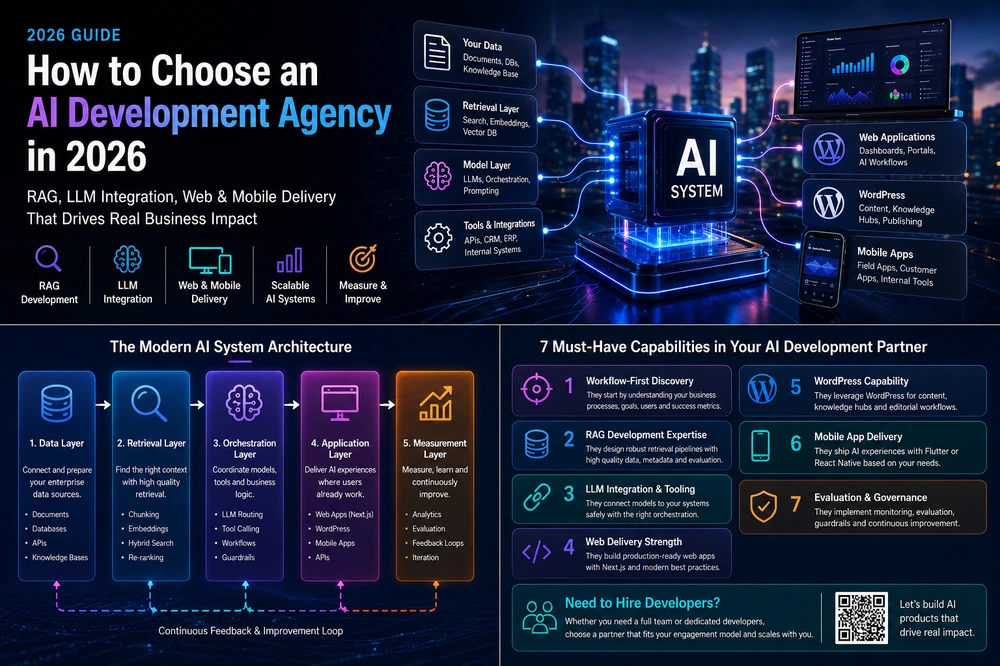
6. Evaluation, monitoring, and governance
A serious agency does not stop at launch. It defines how answers will be evaluated, how failures will be captured, how quality will be reviewed, and how the system will improve over time. That includes prompt and policy iteration, retrieval tuning, tool logs, human feedback loops, and business KPIs.
Ask what happens when the model gives an answer without enough evidence, when an external system times out, or when a user asks for something outside policy. Production readiness is visible in the exception paths.
7. A practical engagement model
Sometimes you need a full product team. Sometimes you only need to hire developers who can plug into your roadmap. A good agency should support both. They should be able to lead discovery and architecture, or embed with your internal product, engineering, and operations teams when you already have direction.
What a production-ready AI stack usually looks like
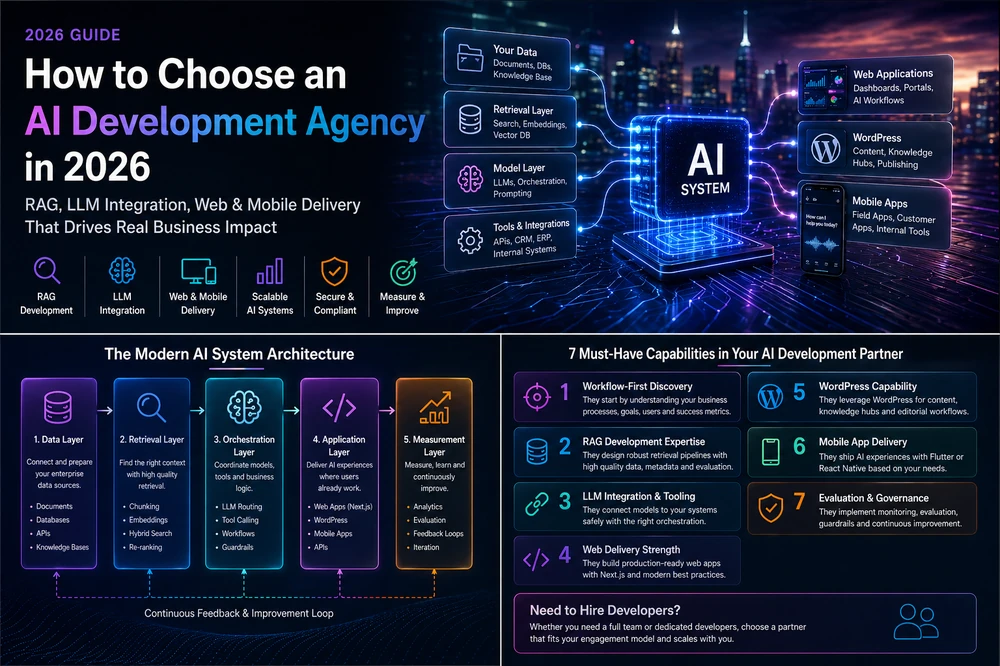
Most business AI systems now need at least five layers:
- Data layer: documents, tickets, knowledge bases, product data, CRM records, or other approved sources.
- Retrieval layer: indexing, embeddings, metadata, ranking, and freshness logic.
- Orchestration layer: prompts, tools, policies, routing, memory boundaries, and decision flows.
- Application layer: web portals, internal dashboards, mobile apps, publishing workflows, or embedded assistants.
- Measurement layer: analytics, evals, human review, incident handling, and iteration.
Your agency should be able to show where each of these lives in your stack. If the plan jumps from “upload docs” to “launch assistant” without these layers being explicit, expect trouble later.
Questions to ask before signing
How do you decide between long-context prompting and retrieval?
A good answer should include tradeoffs around cost, latency, freshness, governance, repeatability, and source grounding. In many workflows, retrieval still matters even when models can accept long context, because businesses need targeted evidence, permissions, and better control over what gets passed to the model.
How do you connect models to business tools safely?
They should talk about least-privilege access, structured tool outputs, logging, approval steps, and clear boundaries between read actions and write actions.
How do you evaluate quality after launch?
They should mention offline eval sets, human review, production feedback, failure tagging, and business metrics rather than relying only on anecdotal demos.
Can you build the surrounding product too?
This question is crucial. Many projects fail because the AI layer works in a lab, but nobody builds the dashboard, content workflow, admin controls, user permissions, mobile app, or analytics layer needed for adoption.
When you need web, WordPress, or mobile around the AI core
Many companies start by asking for an AI assistant and end up needing a broader product system. Here is a practical way to think about it:
- Choose a next.js development approach when you need a modern product interface, authenticated dashboards, admin tools, AI-powered search, or custom workflow applications.
- Choose wordpress development when you need strong editorial control, content operations, publishing workflows, or a marketing and documentation layer around the AI experience.
- Choose flutter development or react native development when the AI feature must be available in customer apps, internal field tools, or mobile-first experiences.
This is why the best partner is often one that can bridge AI development services with web and mobile delivery instead of treating them as separate vendors with disconnected roadmaps.
Red flags that should make you walk away
- They cannot explain retrieval, evaluation, or tool safety in plain language.
- They lead with model brand names but not workflow design.
- They treat every problem as a chatbot problem.
- They cannot show how AI connects to your web or mobile product layer.
- They promise accuracy without discussing data quality, source grounding, or monitoring.
- They have no plan for permissions, auditability, or human review.
- They cannot adapt between dedicated delivery and staff augmentation when you need to hire developers into the effort.
A practical shortlist framework
When comparing agencies, score each one from 1 to 5 across these categories:
- Use-case clarity: Do they understand the workflow and business value?
- RAG development depth: Can they design retrieval, ingestion, and grounding properly?
- LLM integration maturity: Can they connect models, tools, APIs, and governance?
- Web delivery strength: Can they ship portals, dashboards, and admin controls?
- Mobile delivery strength: Can they extend the AI into real mobile use cases?
- Evaluation discipline: Can they measure quality and iterate after launch?
- Team fit: Can they collaborate with your internal team or provide embedded developers when needed?
The highest-scoring partner is usually not the one with the flashiest demo. It is the one that can connect architecture, product delivery, and post-launch improvement into one accountable plan.
Where Cuibit fits
Cuibit is positioned for companies that need an implementation-focused partner across the full stack: AI development services, RAG development, LLM integration services, web development services, Next.js development, WordPress development services, and mobile app development services. That combination matters for businesses that do not just want a model connected to data, but a usable product that employees and customers can rely on.
Final takeaway
In 2026, choosing an AI partner is really about choosing a systems builder. The best AI development agency is the one that can design context-aware AI, connect it to your business systems, and ship the web or mobile experience that turns capability into adoption. Look for depth in retrieval, tool integration, governance, and product delivery. If they can also act as your web development company or mobile delivery partner, you remove friction and give the project a better chance of succeeding in production.
Need this advice turned into a real delivery plan?
We can review your current stack, pressure-test the tradeoffs in this guide and turn it into a scoped implementation plan for your team.