Cuibit publishes insights from shipped delivery work across web, WordPress, AI and mobile. Articles are written for real buying and implementation decisions, then updated as the stack or the advice changes.
Cuibit Web Engineering
Web architecture and technical SEO team
The Cuibit team covering web architecture, Next.js delivery, technical SEO and buyer-facing product surfaces.
Key takeaways
- Choose Flutter if your product depends on highly controlled UI, branded motion, and consistent rendering across iOS and Android.
- Choose React Native if your team already thinks in React, wants JavaScript or TypeScript across app and web, and values ecosystem alignment with modern React tooling.
- In 2026, this is not a simple “performance vs productivity” debate. React Native’s modern architecture is materially stronger than its old reputation suggests, while Flutter remains one of the clearest choices for design-heavy greenfield apps.
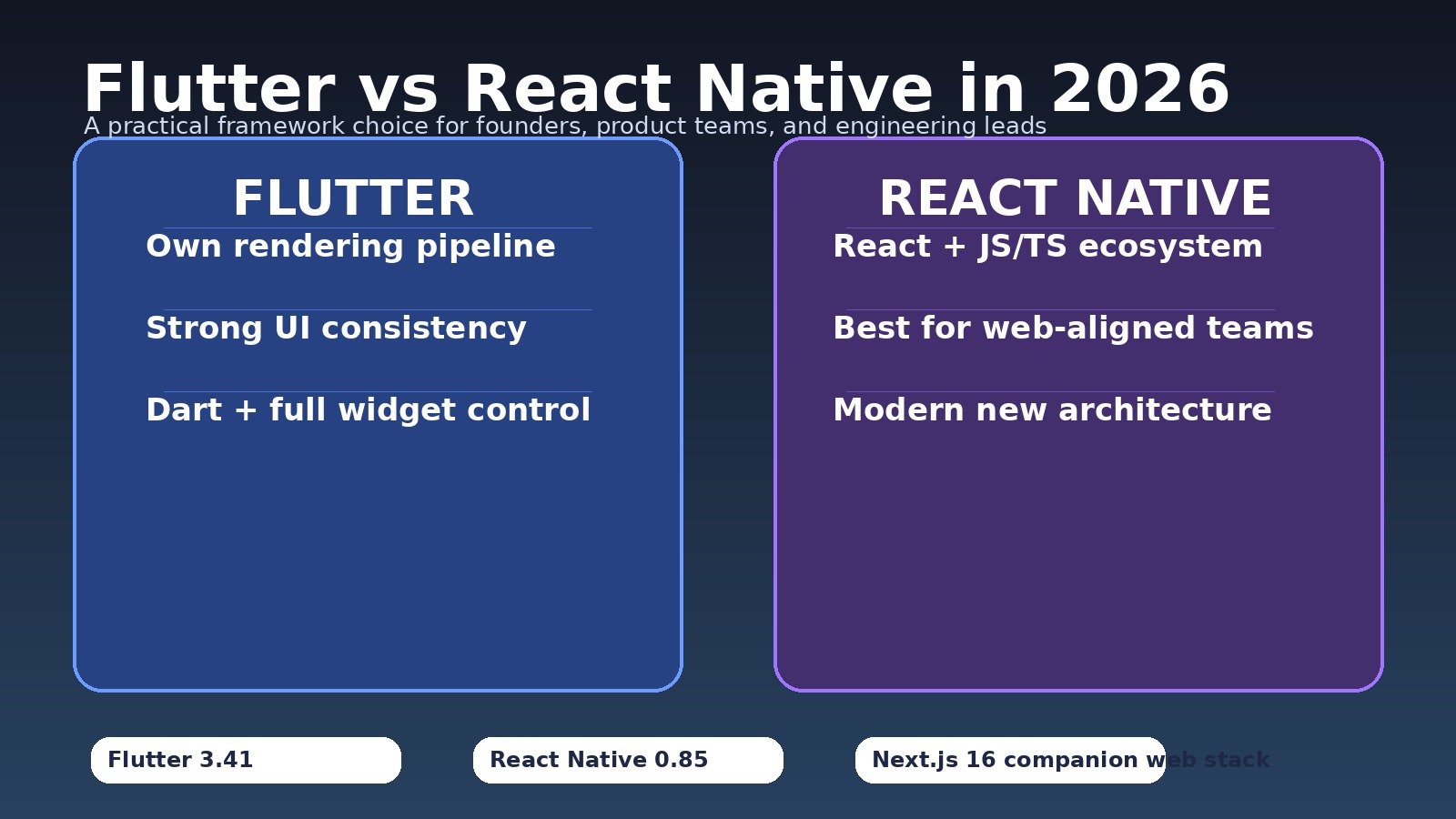
- The latest official releases matter: Flutter 3.41 emphasizes modularity, public release windows, fragment shader improvements, and better native embedding, while React Native 0.85 adds a new animation backend, DevTools improvements, and Metro TLS support.
- For many businesses, the framework decision should be made alongside the web stack and hiring plan. If your mobile app also needs a dashboard, admin portal, or customer-facing web app, a paired stack with Next.js development can change the decision.
If you want the direct answer first, here it is: Flutter is usually the better choice for design-led products that need precise, consistent UI behavior, while React Native is usually the better choice for teams that already invest heavily in React and want maximum talent portability across mobile and web. That is the clearest way to think about Flutter vs React Native in 2026.
Neither framework is obsolete. Neither is automatically better. The right pick depends on what kind of app you are building, how much native customization you expect, what skills your team already has, and how closely your mobile roadmap is tied to a shared web stack. This guide breaks that down in practical terms, with current framework context rather than recycled 2022 talking points.
Quick verdict
For most companies, the decision should look like this:
| If your priority is... | Better default | |---|---| | Pixel-perfect custom UI and motion | Flutter | | Reusing React and JavaScript talent | React Native | | A heavily branded greenfield app | Flutter | | A product team already shipping React web apps | React Native | | One team sharing app and web thinking | React Native | | Strict visual consistency across platforms | Flutter | | Long-term mobile product with custom interactions | Flutter | | Faster staffing from the React ecosystem | React Native |
That quick verdict will be right for most buyers, but the details matter.
What changed in 2026 that makes this comparison worth updating
A lot of online Flutter vs React Native content is stale. It still frames React Native as if it were stuck in its older architecture, or it talks about Flutter without accounting for how much the framework and its tooling have matured.
The official release notes tell a more current story. Flutter 3.41 highlights public release windows, more modular design libraries, fragment shader improvements, and content-sized views that make it easier to embed Flutter into existing native apps. React Native 0.85 adds a new animation backend, DevTools improvements, Metro TLS support, and packaging changes around the Jest preset. React Native also reached a major milestone in late 2025, with 0.82 becoming the first release that runs entirely on the New Architecture. Official React Native documentation explains that the New Architecture adds support for modern React features and direct access to native interfaces without the old bridge model.
That means the old shorthand — “Flutter is modern, React Native is compromised” — is too simplistic in 2026.
The real difference between Flutter and React Native
At a practical level, these frameworks make different tradeoffs.
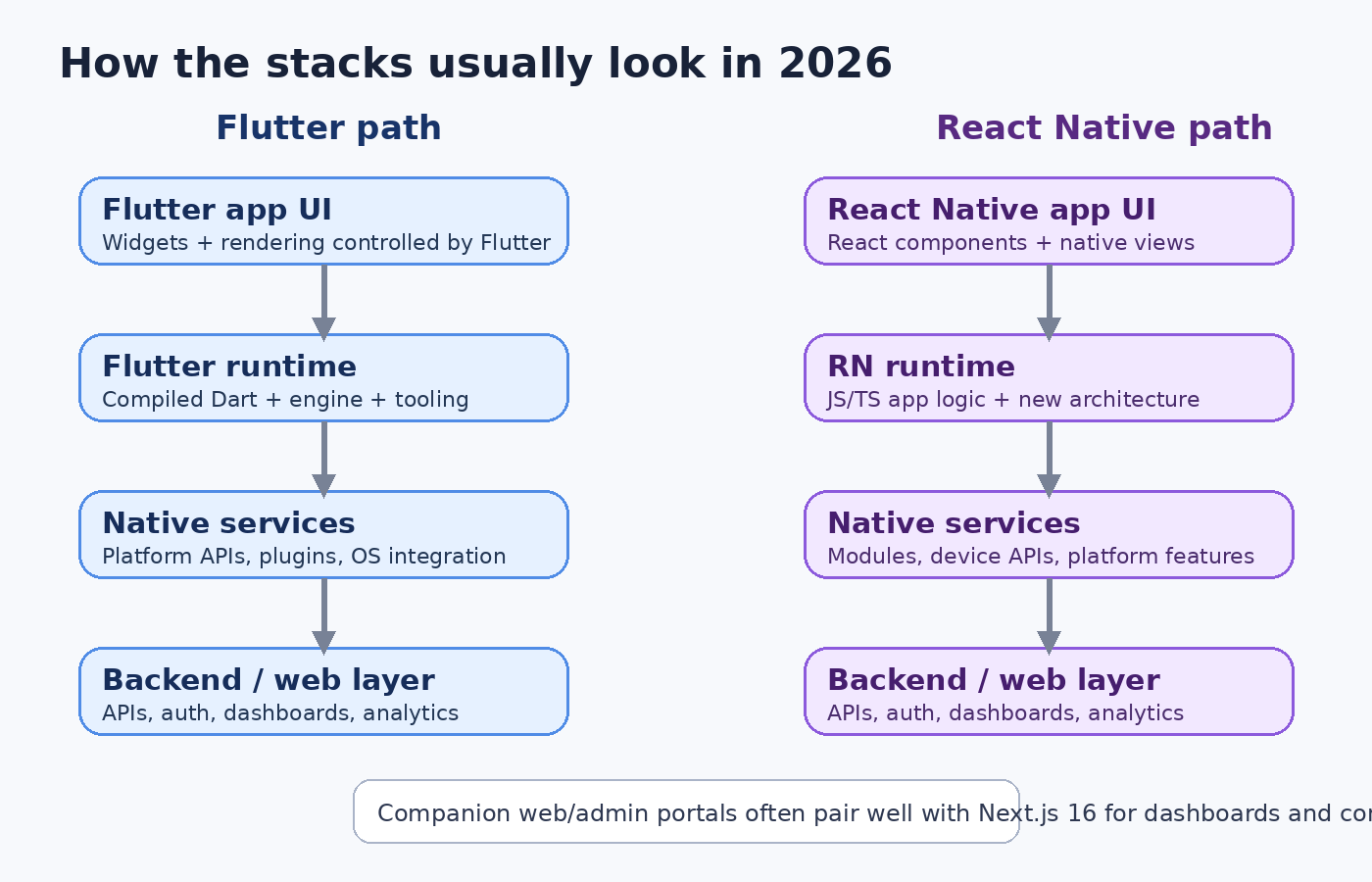
Flutter gives you a UI toolkit and rendering approach that stays highly consistent across platforms. Flutter’s own documentation for React Native developers emphasizes that Flutter compiles to native code and controls each pixel on the screen. That is a big reason teams choose it for custom visual work and motion-heavy interfaces.
React Native is a React-based mobile framework that uses native platform capabilities and now sits on a much more modern architecture than it did a few years ago. If your team already builds in React, the mental model, hiring pool, and code organization patterns often feel more natural.
So the real question is not “Which one is better?” It is:
- Do you want maximum UI control?
- Or do you want maximum alignment with the broader React ecosystem?
That choice often predicts success more accurately than benchmark arguments.
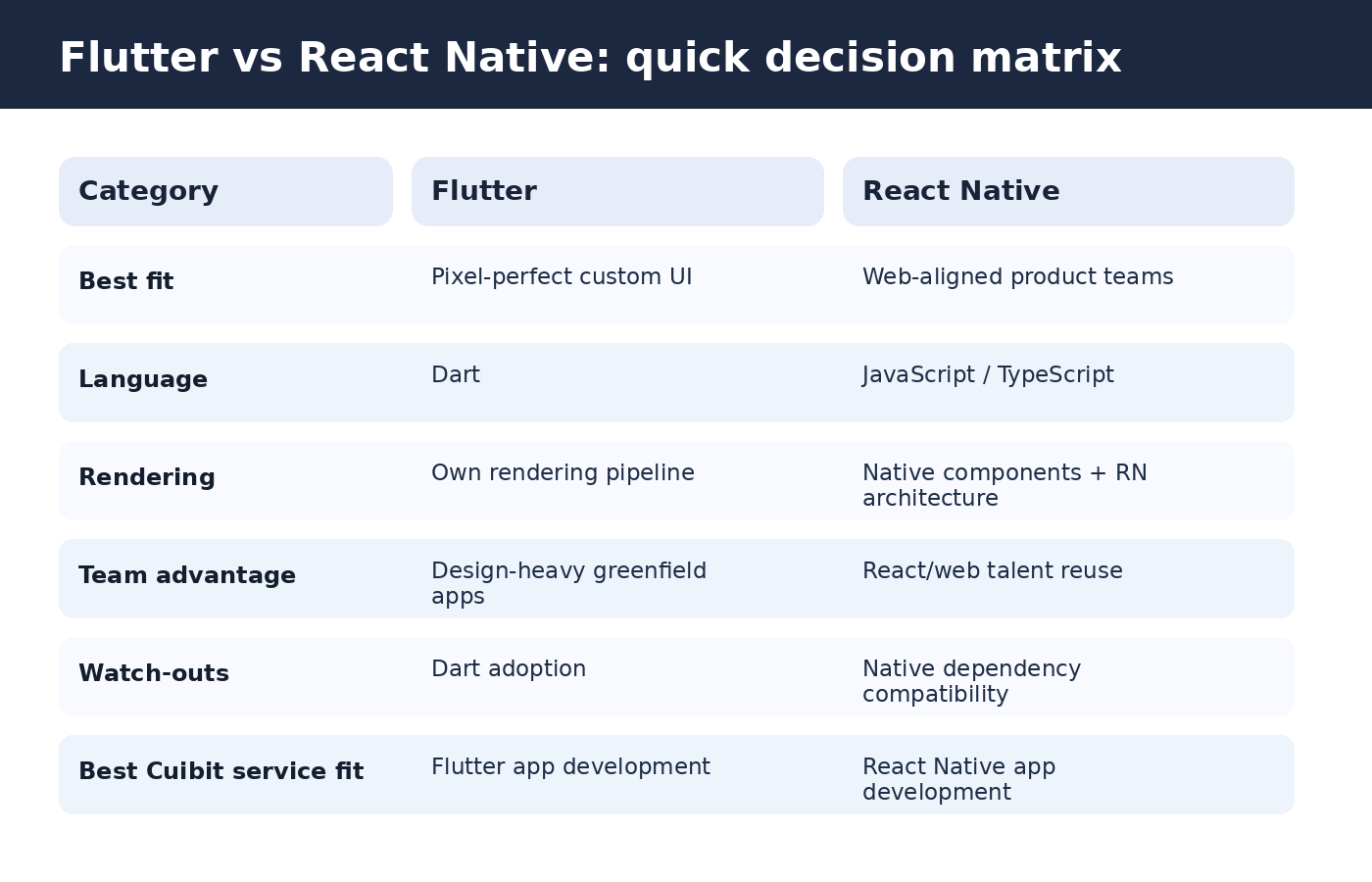
Flutter vs React Native at a glance
Developer language and team fit
Flutter means committing to Dart. That is not a disaster, but it is still a real choice. Teams with strong JavaScript or TypeScript hiring pipelines sometimes underestimate the cost of introducing another language and a new set of conventions.
React Native lets you stay with JavaScript or TypeScript, which still matters for agencies, startups, and product teams that want tighter hiring overlap between mobile and web.
Rendering and UI control
Flutter remains the cleaner choice for teams that care deeply about:
- consistent rendering,
- custom animations,
- bespoke visual systems,
- and fewer platform-level visual surprises.
Flutter’s official guidance continues to position this as a core strength. For app categories where visual polish is part of the product value — fintech dashboards, health apps, premium consumer products, branded marketplaces — that advantage can be very real.
React Native can absolutely ship polished apps too. But if your design team wants total control over how every layer behaves, Flutter usually gives fewer excuses and fewer visual edge cases.
Ecosystem alignment
React Native still has the edge when the question is broader than mobile. If your mobile app sits beside:
- a React web app,
- a Next.js marketing site,
- an internal dashboard,
- or a customer portal,
then the broader ecosystem fit becomes a serious decision factor.
This is why React Native often makes sense for companies that also need web development services or a companion Next.js development engagement. One shared engineering culture can matter more than a narrow framework win.
Performance: what matters in practice
This category gets oversimplified constantly.
Flutter’s official performance guidance says Flutter apps are generally performant by default if you avoid known pitfalls. That lines up with why many teams still trust Flutter for animation-rich and UI-intensive apps.
React Native has also improved materially. React Native 0.85’s new animation backend is designed to move more animation logic into core and improve how Animated and Reanimated behave under the hood. The framework is also no longer defined by the old bridge-only story; its New Architecture was built specifically to modernize rendering, native interop, and thread scheduling.
So in practice:
- Flutter still has the cleaner reputation for UI-heavy experiences.
- React Native is stronger in 2026 than many comparison posts admit.
- For many business apps, the bigger bottlenecks are still app architecture, image handling, network design, and weak engineering decisions — not the framework itself.
DX and maintenance
Where Flutter feels better
Flutter often feels better when:
- the product is greenfield,
- the design language is highly custom,
- and the team wants one opinionated way of building the interface.
Flutter 3.41’s push toward more modular design libraries also suggests a framework that is trying to give teams more control over how design changes are adopted.
Where React Native feels better
React Native often feels better when:
- your engineers already know React,
- you want to reuse shared patterns with web,
- you hire heavily from the JavaScript market,
- or you expect the product to sit inside a larger React platform.
React Native 0.85 also improves the tooling story with better DevTools workflows and multiple simultaneous CDP connections, which is increasingly relevant in AI-assisted and multi-tool debugging setups.
Best by use case
Best for startups building fast with a React-heavy team
React Native
If your startup already has React engineers and needs to move quickly across marketing site, dashboard, and mobile app, React Native is usually the better business choice. The technical tradeoff is often worth it because hiring and workflow complexity matter more than theoretical purity.
Best for premium UI and branded consumer apps
Flutter
If your product’s differentiation is tied to visual polish, transitions, and a highly controlled design system, Flutter usually gives you the stronger default.
Best for teams building mobile plus a serious web companion
React Native
When the product also needs a robust web control plane, React Native gets stronger — especially if the same organization is already investing in Next.js development services for the browser side.
Best for long-lived custom mobile products
Flutter, with an important caveat.
Flutter is often the better fit when the app itself is the product and the experience is highly custom. But only choose it if your organization is actually comfortable owning a Dart-based engineering path.
Best for agencies and businesses that need flexible staffing
React Native
The JavaScript and TypeScript hiring pool still gives React Native an advantage for many service teams. That matters if you plan to hire React Native developers quickly or scale a team around existing React capabilities.
Best for motion-heavy interfaces and UI experimentation
Flutter
Flutter remains a strong default when the design team wants unusual transitions, heavily customized components, or a more app-like visual system than a platform-native one.
What businesses often get wrong when choosing
Mistake 1: choosing on internet arguments instead of product constraints
A framework debate is not a strategy. Your actual decision should reflect:
- hiring market,
- time to ship,
- design expectations,
- native module needs,
- and whether your web stack matters as much as mobile.
Mistake 2: treating hiring as a secondary issue
Hiring is architecture. If you cannot realistically staff a Dart team, Flutter may be the wrong answer even if the UI is beautiful. If your team is deeply React-native in culture and background, forcing a full Flutter move may create friction you do not need.
Mistake 3: underestimating native dependencies
Both frameworks still need careful evaluation when your roadmap includes heavy native integrations, uncommon SDKs, or edge-case device capabilities. React Native’s modern interop story is better than before, but library compatibility still deserves review. Flutter is strong here too, but plugin quality is never something to assume blindly.
How Cuibit would frame the decision
If the main question is cross-platform delivery with strong business execution, start with the product model:
- If you need a tailored design-heavy mobile experience, explore Flutter app development.
- If your product strategy is already tied to React, dashboards, and web/mobile team overlap, explore React Native app development.
- If the app is part of a larger digital platform, the framework decision should be made together with mobile app development services and related web architecture planning.
- If you want to scale quickly, staffing strategy matters too: hire Flutter developers when custom UI is the differentiator, and hire React Native developers when React ecosystem leverage is the bigger win.
Final verdict
Here is the most honest editorial recommendation:
Choose Flutter if you care most about precise UI control, branded interaction design, and a mobile experience that should feel crafted from the rendering layer up.
Choose React Native if you care most about React ecosystem alignment, staffing flexibility, shared engineering culture across app and web, and faster leverage of existing JavaScript or TypeScript talent.
Neither answer fits everyone. That is exactly why this comparison still matters in 2026.
The wrong way to choose is to ask which framework wins the internet. The right way is to ask which framework reduces risk and increases leverage for the product you are actually building.
Sources and scope
Platform behavior can change. Check the documentation for the version and account you use. Recommendations in this guide do not guarantee a ranking, performance gain, compliance outcome or project result.
Need this advice turned into a real delivery plan?
We can review your current stack, pressure-test the tradeoffs in this guide and turn it into a scoped implementation plan for your team.