Cuibit publishes insights from shipped delivery work across web, WordPress, AI and mobile. Articles are written for real buying and implementation decisions, then updated as the stack or the advice changes.
Cuibit AI Systems
Applied AI and LLM delivery team
The Cuibit team focused on production RAG, LLM integration, workflow automation, evaluation and model cost control.
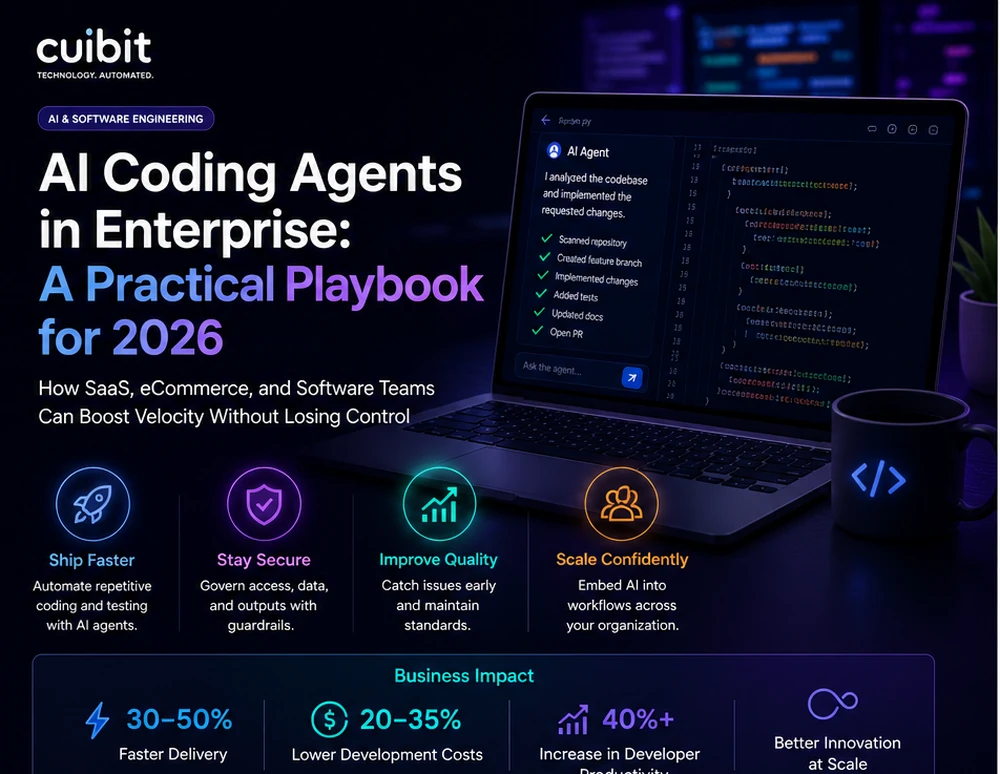
AI Coding Agents Governance Playbook for Software Teams in 2026
AI coding agents are becoming part of software delivery, but the real business question is not whether an agent can write code. The real question is whether a company can use AI coding tools without creating security, quality, compliance, and maintainability problems. This makes governance a practical engineering topic for SaaS, ecommerce, WordPress, mobile, and custom web teams.
For Cuibit, this is a new angle from the prior WooCommerce AI-agent topic. It focuses on software teams and delivery systems rather than store automation. The goal is to help CTOs, founders, and product teams decide where AI coding agents fit safely into production development.
Key takeaways
- AI coding agents can improve delivery speed, but only with clear guardrails.
- The highest-value use cases are testing, documentation, refactoring support, issue triage, migration assistance, and code review preparation.
- Agents should not merge production changes without review.
- Security, dependency control, prompt standards, repository permissions, and audit logs matter.
- AI coding workflows should be measured by shipped quality, not generated lines of code.
Why AI coding agents are different from autocomplete
Autocomplete suggests snippets. Coding agents can inspect repositories, modify files, run commands, draft tests, open pull requests, and reason across issues. That makes them more useful and more risky. They operate closer to the delivery workflow, where mistakes can affect users, security, cost, and future maintainability.
A company should treat agents like junior contributors with unusual speed. They need scopes, permissions, review, test requirements, and coding standards. The fact that an agent can modify many files quickly is not automatically an advantage if the team cannot review the change safely.
Start with low-risk workflows
The best first use cases are supportive rather than autonomous. Ask agents to summarize issues, identify affected files, draft unit tests, explain legacy modules, generate migration checklists, update documentation, or prepare pull request descriptions. These tasks save engineering time without granting broad control over production behavior.
Once the team has confidence, agents can support refactoring, dependency upgrades, accessibility fixes, test coverage, and repetitive frontend changes. Even then, a human should own the final decision.
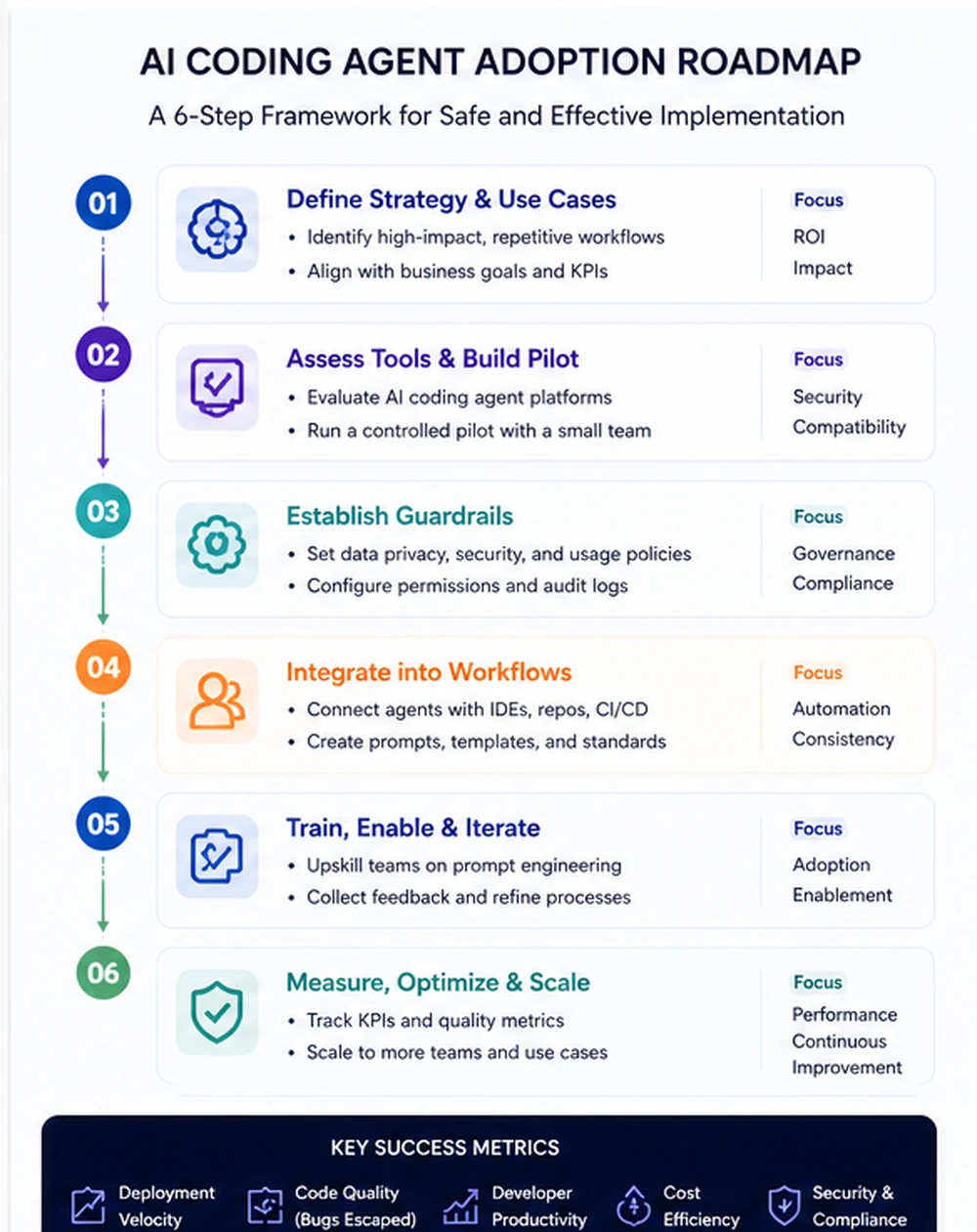
Create repository permissions carefully
Agents should not have the same permissions as senior engineers by default. Use scoped tokens, branch protections, required reviews, CI gates, and limited access to secrets. Prevent agents from reading production credentials, customer data, or private environment variables unless a specific approved workflow requires it.
This is especially important for ecommerce, healthcare, finance, B2B SaaS, and internal operations software. A careless AI workflow can leak sensitive data or introduce compliance risk.
Define code-quality gates
Every agent-generated change should pass the same gates as human code: formatting, linting, type checks, unit tests, integration tests, security scanning, dependency review, and code review. If the agent cannot run tests or explain the impact, the change is not ready.
Teams should also measure downstream quality. Did the agent reduce cycle time? Did it increase review burden? Did it introduce defects? Did documentation improve? The point is better software delivery, not impressive demos.
Use agents for migrations and modernization
AI coding agents are useful during migrations because they can identify repeated patterns, draft refactors, generate tests, and summarize dependencies. For example, a team upgrading a React app, modernizing a PHP backend, improving a Next.js route structure, or cleaning a WordPress plugin can use agents to accelerate discovery and repetitive work.
Cuibit’s backend development and React development work often involves exactly these patterns: repeated refactors, careful testing, and architecture decisions that need senior review.
The operating model for AI-assisted delivery
A mature model has five parts: approved use cases, permission scopes, review process, measurable quality gates, and ongoing governance. Document which repositories agents may access, which commands they may run, which files they may modify, and which tasks require human approval.
Add a simple rule: agents can propose, but humans own production. That keeps the workflow useful without letting automation outrun accountability.
A 30-day adoption plan
Week one: choose two low-risk workflows and define policies. Week two: run pilot tasks on non-critical repositories. Week three: measure review time, quality, and developer feedback. Week four: expand only the workflows that clearly helped. Do not scale an agent across all repositories until the team has proven the operating model.
The teams that win will be the teams that use AI coding agents calmly, not the teams that give agents uncontrolled access because the demo looked good. Teams that need production workflow support can connect this work to AI automation services, LLM integration services, and portfolio-style delivery such as developer tool MVP planning.
Editorial conclusion
AI coding agents can help software teams move faster, but speed is useful only when quality and accountability remain intact. The right governance model turns agents into accelerators for testing, documentation, modernization, and review preparation without giving away control of production software.
For related Cuibit work, review web development services backend development.
Additional operating notes
A practical implementation should include ownership, documentation, release monitoring, training, and post-launch review. Teams should track what changed, who approved it, how performance moved, and what risks remain. This makes the work maintainable after the article is published and helps the business avoid repeating the same technical debt.
Additional operating notes
A practical implementation should include ownership, documentation, release monitoring, training, and post-launch review. Teams should track what changed, who approved it, how performance moved, and what risks remain. This makes the work maintainable after the article is published and helps the business avoid repeating the same technical debt.
Additional operating notes
A practical implementation should include ownership, documentation, release monitoring, training, and post-launch review. Teams should track what changed, who approved it, how performance moved, and what risks remain. This makes the work maintainable after the article is published and helps the business avoid repeating the same technical debt.
Additional operating notes
A practical implementation should include ownership, documentation, release monitoring, training, and post-launch review. Teams should track what changed, who approved it, how performance moved, and what risks remain. This makes the work maintainable after the article is published and helps the business avoid repeating the same technical debt.
Additional operating notes
A practical implementation should include ownership, documentation, release monitoring, training, and post-launch review. Teams should track what changed, who approved it, how performance moved, and what risks remain. This makes the work maintainable after the article is published and helps the business avoid repeating the same technical debt.
Additional operating notes
A practical implementation should include ownership, documentation, release monitoring, training, and post-launch review. Teams should track what changed, who approved it, how performance moved, and what risks remain. This makes the work maintainable after the article is published and helps the business avoid repeating the same technical debt.
Additional operating notes
A practical implementation should include ownership, documentation, release monitoring, training, and post-launch review. Teams should track what changed, who approved it, how performance moved, and what risks remain. This makes the work maintainable after the article is published and helps the business avoid repeating the same technical debt.
Additional operating notes
A practical implementation should include ownership, documentation, release monitoring, training, and post-launch review. Teams should track what changed, who approved it, how performance moved, and what risks remain. This makes the work maintainable after the article is published and helps the business avoid repeating the same technical debt.
Additional operating notes
A practical implementation should include ownership, documentation, release monitoring, training, and post-launch review. Teams should track what changed, who approved it, how performance moved, and what risks remain. This makes the work maintainable after the article is published and helps the business avoid repeating the same technical debt.
Additional operating notes
A practical implementation should include ownership, documentation, release monitoring, training, and post-launch review. Teams should track what changed, who approved it, how performance moved, and what risks remain. This makes the work maintainable after the article is published and helps the business avoid repeating the same technical debt.
Additional operating notes
A practical implementation should include ownership, documentation, release monitoring, training, and post-launch review. Teams should track what changed, who approved it, how performance moved, and what risks remain. This makes the work maintainable after the article is published and helps the business avoid repeating the same technical debt.
Additional operating notes
A practical implementation should include ownership, documentation, release monitoring, training, and post-launch review. Teams should track what changed, who approved it, how performance moved, and what risks remain. This makes the work maintainable after the article is published and helps the business avoid repeating the same technical debt.
Additional operating notes
A practical implementation should include ownership, documentation, release monitoring, training, and post-launch review. Teams should track what changed, who approved it, how performance moved, and what risks remain. This makes the work maintainable after the article is published and helps the business avoid repeating the same technical debt.
Additional operating notes
A practical implementation should include ownership, documentation, release monitoring, training, and post-launch review. Teams should track what changed, who approved it, how performance moved, and what risks remain. This makes the work maintainable after the article is published and helps the business avoid repeating the same technical debt.
Additional operating notes
A practical implementation should include ownership, documentation, release monitoring, training, and post-launch review. Teams should track what changed, who approved it, how performance moved, and what risks remain. This makes the work maintainable after the article is published and helps the business avoid repeating the same technical debt.
Additional operating notes
A practical implementation should include ownership, documentation, release monitoring, training, and post-launch review. Teams should track what changed, who approved it, how performance moved, and what risks remain. This makes the work maintainable after the article is published and helps the business avoid repeating the same technical debt.
Additional operating notes
A practical implementation should include ownership, documentation, release monitoring, training, and post-launch review. Teams should track what changed, who approved it, how performance moved, and what risks remain. This makes the work maintainable after the article is published and helps the business avoid repeating the same technical debt.
Additional operating notes
A practical implementation should include ownership, documentation, release monitoring, training, and post-launch review. Teams should track what changed, who approved it, how performance moved, and what risks remain. This makes the work maintainable after the article is published and helps the business avoid repeating the same technical debt.
Additional operating notes
A practical implementation should include ownership, documentation, release monitoring, training, and post-launch review. Teams should track what changed, who approved it, how performance moved, and what risks remain. This makes the work maintainable after the article is published and helps the business avoid repeating the same technical debt.
Additional operating notes
A practical implementation should include ownership, documentation, release monitoring, training, and post-launch review. Teams should track what changed, who approved it, how performance moved, and what risks remain. This makes the work maintainable after the article is published and helps the business avoid repeating the same technical debt.
Additional operating notes
A practical implementation should include ownership, documentation, release monitoring, training, and post-launch review. Teams should track what changed, who approved it, how performance moved, and what risks remain. This makes the work maintainable after the article is published and helps the business avoid repeating the same technical debt.
Additional operating notes
A practical implementation should include ownership, documentation, release monitoring, training, and post-launch review. Teams should track what changed, who approved it, how performance moved, and what risks remain. This makes the work maintainable after the article is published and helps the business avoid repeating the same technical debt.
Additional operating notes
A practical implementation should include ownership, documentation, release monitoring, training, and post-launch review. Teams should track what changed, who approved it, how performance moved, and what risks remain. This makes the work maintainable after the article is published and helps the business avoid repeating the same technical debt.
Additional operating notes
A practical implementation should include ownership, documentation, release monitoring, training, and post-launch review. Teams should track what changed, who approved it, how performance moved, and what risks remain. This makes the work maintainable after the article is published and helps the business avoid repeating the same technical debt.
Additional operating notes
A practical implementation should include ownership, documentation, release monitoring, training, and post-launch review. Teams should track what changed, who approved it, how performance moved, and what risks remain. This makes the work maintainable after the article is published and helps the business avoid repeating the same technical debt.
Additional operating notes
A practical implementation should include ownership, documentation, release monitoring, training, and post-launch review. Teams should track what changed, who approved it, how performance moved, and what risks remain. This makes the work maintainable after the article is published and helps the business avoid repeating the same technical debt.
Additional operating notes
A practical implementation should include ownership, documentation, release monitoring, training, and post-launch review. Teams should track what changed, who approved it, how performance moved, and what risks remain. This makes the work maintainable after the article is published and helps the business avoid repeating the same technical debt.
Additional operating notes
A practical implementation should include ownership, documentation, release monitoring, training, and post-launch review. Teams should track what changed, who approved it, how performance moved, and what risks remain. This makes the work maintainable after the article is published and helps the business avoid repeating the same technical debt.
Additional operating notes
A practical implementation should include ownership, documentation, release monitoring, training, and post-launch review. Teams should track what changed, who approved it, how performance moved, and what risks remain. This makes the work maintainable after the article is published and helps the business avoid repeating the same technical debt.
Additional operating notes
A practical implementation should include ownership, documentation, release monitoring, training, and post-launch review. Teams should track what changed, who approved it, how performance moved, and what risks remain. This makes the work maintainable after the article is published and helps the business avoid repeating the same technical debt.
Additional operating notes
A practical implementation should include ownership, documentation, release monitoring, training, and post-launch review. Teams should track what changed, who approved it, how performance moved, and what risks remain. This makes the work maintainable after the article is published and helps the business avoid repeating the same technical debt.
Additional operating notes
A practical implementation should include ownership, documentation, release monitoring, training, and post-launch review. Teams should track what changed, who approved it, how performance moved, and what risks remain. This makes the work maintainable after the article is published and helps the business avoid repeating the same technical debt.
Additional operating notes
A practical implementation should include ownership, documentation, release monitoring, training, and post-launch review. Teams should track what changed, who approved it, how performance moved, and what risks remain. This makes the work maintainable after the article is published and helps the business avoid repeating the same technical debt.
Additional operating notes
A practical implementation should include ownership, documentation, release monitoring, training, and post-launch review. Teams should track what changed, who approved it, how performance moved, and what risks remain. This makes the work maintainable after the article is published and helps the business avoid repeating the same technical debt.
Need this advice turned into a real delivery plan?
We can review your current stack, pressure-test the tradeoffs in this guide and turn it into a scoped implementation plan for your team.